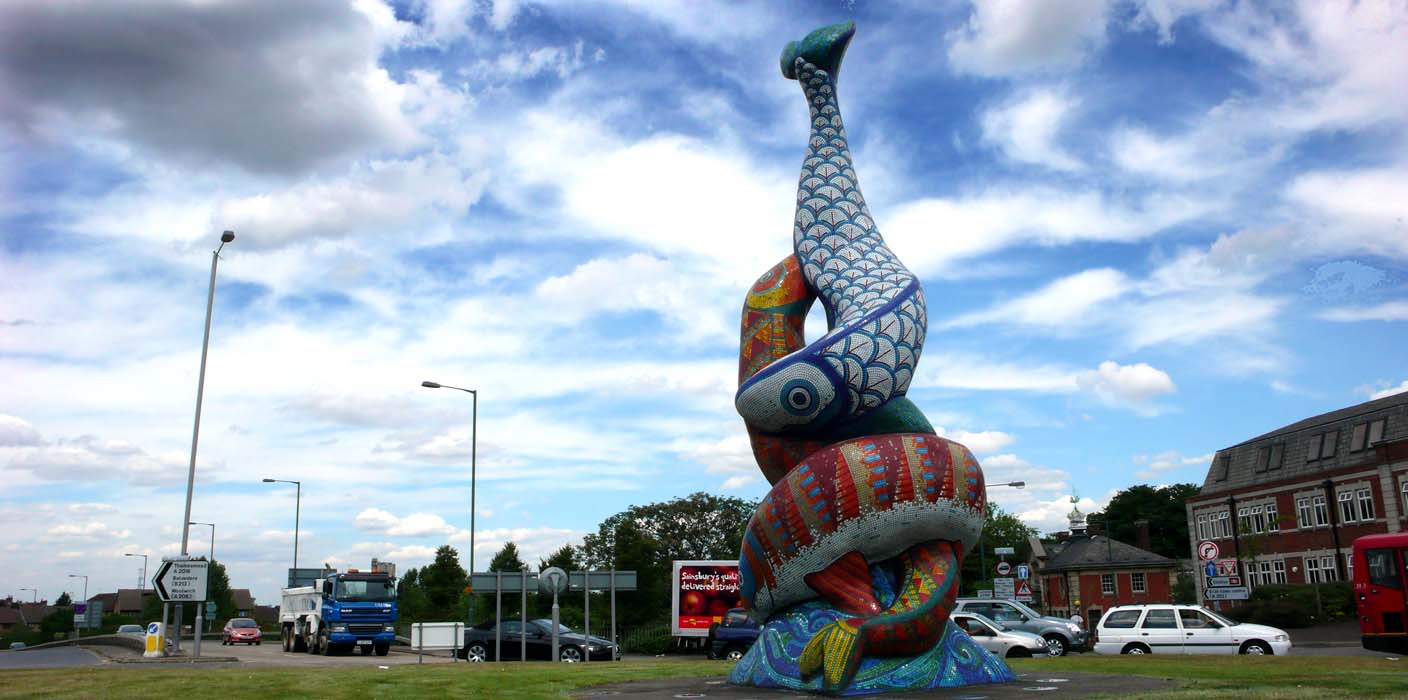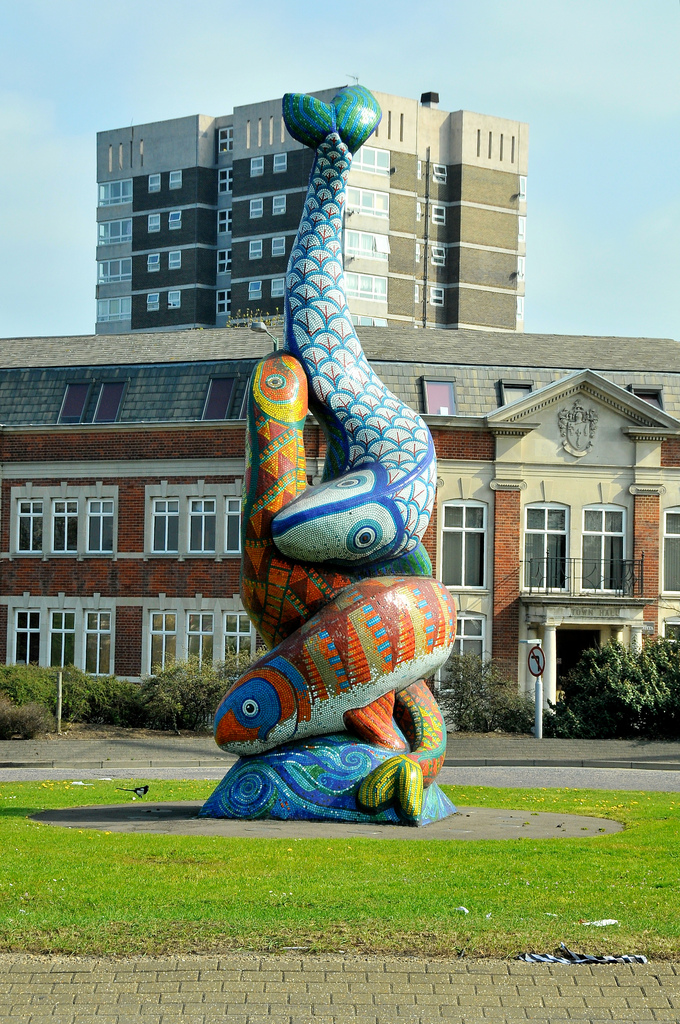
Anyone who has ever visited, or even passed through Erith will be familiar with the object above - the infamous Erith Fish Sculpture, which occupies the centre of the roundabout in the town centre which connects Bronze Age Way, Queen's Road, Bexley Road and Fraser Road. Opinion on the sculpture is divided. As many long term readers will know, I have not been a fan since it was installed; in fact I originally described it as a "hideous psychedelic "Mister Whippy" style turd crapped on the town by some passing space alien". My views have now moderated somewhat. Erith is now so well known (notorious?) for the fish roundabout that it has become a real local landmark, and a key part of the identity of the town. I have been asked by people unfamiliar with the area how they will know when they have reached their destination. My response has been - "when you see the fish roundabout, trust me you will know!" The fish sculpture was created by local artist Gary Drostle, who has his studio in the Europa Industrial Estate in Fraser Road, less than five minutes walk from the roundabout. Gary is set to create several unique artworks for the Erith Quarry residential development site that is bounded by Bexley Road and Fraser Road. In an interview with the Bexley Times last week, Gary Drostle said:- "It’s always a pleasure to work on a project so close to home,” said Mr Drostle. In this case the mural will be displayed just minutes from my studio on Fraser Road! The Quarry has a fascinating history, which will be a key source of inspiration for my artwork, and I am looking forward to working with London and Quadrant and Anderson's over the coming months to produce something the whole community will be able to enjoy.” Let's just hope Gary creates something a little less challenging for local residents this time around. The first houses on the Erith Quarry site are due to be completed some time late in the summer. I will be visiting the development to give an update on progress in the fairly near future. Back in 1973 the site now occupied by the Gary Drostle fish sculpture roundabout was then the location of the Wheatley Hotel - a Railway Hotel. A Railway Hotel was a combination of a pub downstairs, and a bed and breakfast upstairs; almost all railway stations at one stage or other had a railway hotel in close proximity - in this case, Erith Station was just across the road. In the time before the invention of the car, people travelling around the country would often need to break their train journey overnight. A room in a railway hotel was cheaper than a full hotel, as the features tended to be more basic, but they were convenient - they fulfilled the same function as a modern Premier Inn - cheap and clean, at least in most cases. On top of this, local residents would use the pub located on the ground floor. I understand that the Wheatley Hotel was a pretty lively place on a Friday and Saturday night.
Nowadays Bexley is served by the excellent Bexley Brewery, located on the Manford Industrial Estate at the far Eastern end of Manor Road, just beneath the Erith Wind Turbine. The brewery is extremely successful, and produces some absolutely top notch ales, of which I am a great fan indeed - I was in the brewery on Friday lunchtime, picking up a couple of fresh pints for the weekend; whilst I was there a film crew were filming head brewer Cliff as he prepared a new brew. I have no idea what the filming is for, but no doubt I will find out sooner rather than later. It was not always the case. The local area was poorly served by local brewers for a very long time, although one former brewery certainly divided opinion. If you ask a number of retired people who have lived locally for any length of time about Beasley’s Beer, you will get a number of responses – not all of them good. Beasley’s Brewery was located in Plumstead, in Brewery road, off Lakedale Road. Before the Second World War, it was owned by Harry Geoffrey Beasley, who had inherited the brewery. The income from this made him wealthy, and enabled him to spend much of his life engaged in his passion for anthropology; he travelled the world studying various tribes and peoples, and wrote many academic papers on the subject. He was considered to be a leader in his field of study, and in 1932 he became president of The Royal Anthropological Institute, a post he held until 1937, when ill – health in the form of Diabetes meant he had to stand down from the office. For most of his married life he lived in Cranmore House in Chislehurst, where he set up the Cranmore Ethnographical Museum, which housed six thousand exhibits that Beasley had collected during his travels. He died in 1939, when his collection was moved to the British Museum – just in time, as the house was destroyed during the Blitz. From the records I have read, Harry Beasley had a pretty hands – off relationship with the brewery from which he derived his not inconsiderable income. Some time ago, Local resident Roger Jewiss recalled the following story about day to day life for the average working man in Beasley’s Brewery: "My Grandfather was a blacksmith and during the depression found work a bit hard to find. He was pleased to get two days work to do a repair in the brewery. All employees were given two brass tokens a day which they could exchange for a pint of beer. My grandfather, very hot at his temporary forge, had used his tokens and was indeed very pleased when a brewery worker called down to him, “ Fancy a pint blacky?” “ Not 'arf,” replied my grandfather. Soon after, a copper vessel came slowly down from the vat above, on a long wire, and my grandfather gratefully quenched his thirst. “ Thanks”, he shouted back to his new friend, “that certainly was a long pint.” “PINT!” came the reply, “that vessel held a gallon!”. The account was originally published on the Plumstead Stories website that you can see here. My Grandfather on my Mum’s side (and indeed my Mum) called the output of the brewery “Beasley’s beastly beer” as they both heartily loathed it. Apparently this was a not uncommon opinion at the time, thought for a period I understand that their beers had a royal warrant – if anyone has any details, I would love to hear from them. Beasley’s Brewery was taken over by the much larger Courage in 1963; not much later it was closed down. You can see a collection of Beasley Brewery photographs and beer mats which have been framed and hung on the wall of the excellent Robin Hood and Little John pub in Lion Road, Bexleyheath.

Regular Maggot Sandwich reader Deborah contacted me shortly after I published last week's Blog update to let me know that Vox amplifier inventor Dick Denney was her Mum's next door neighbour for many years. His idea grew from a portable amplifier-speaker unit he developed, while convalescing from illness in 1952, for use with his Hawaiian guitar. In 1955, Dick demonstrated his system - not the first to be made in this country, but certainly the most effective - to the owner of a Dartford music shop, Tom Jennings, who proposed a joint manufacturing venture. So began Jennings Musical Industries, and the trademark, Vox, was applied to all Dick's JMI work. Indeed, the early 1960s rise of British guitar groups caused an explosion of interest that left JMI struggling to keep up with demand. Dick produced three more original designs - a 100-watt amplifier, three times the power of any previous equipment; a guitar-organ, allowing the guitarist to produce his own accompaniment; and a wireless microphone system, the forerunner of those used in today's stage musicals. This was on top of his work on his most famous creation, the Vox AC30 amplifier - the sound of the "British Invasion". Dick was born in Erith, and, at an early age, became interested in the guitar and amateur radio, whose novelty attracted thousands of hobbyists in the 1930s and to this day. He was soon a leading exponent of the Hawaiian guitar, and his radio skills enabled him to listen to American shortwave radio broadcasts, which inspired his creation of instruments and amplifying equipment. His fragile health excluded him from wartime armed forces; instead, he worked at Vickers' munitions factory, in Crayford, where he first met the accordion-playing Jennings, who shared his interest in musical innovation. After the war, Dick ran a radio and sound equipment shop at Belvedere, Kent, until illness - and the idea for the Vox - struck in 1952. Jennings sold JMI in 1964, by which time a franchise agreement had been struck with an American manufacturer for use of the Vox name. Dick left the company in 1967 to pursue a career as an independent consultant and designer, which he maintained until his death. You can see a very rare clip of Dick Denney on American TV quiz / light entertainment show "I've got a Secret" where he demonstrates the then brand new and very far ahead of its time Vox V251 Guitar Organ to a somewhat confused panel of contestants. The guitar organ shown in the video was the prototype, and the only one in existence when the TV show was filmed. Around seventy hand built models followed, but due to the bulk, requirement for an additional external power supply and the complexity of the guitar organ, not to mention the weight around the players' neck, the model may have been groundbreaking, but it was never a big seller. It was a direct predecessor, and inspiration to the SynthAxe of the mid 1980's. Yet another case of Vox being ahead of the game by a considerable distance.
One reader posted the following comment on Vox / JML last week:- "Your article on JMI brought back a few memories! I worked there in the office from 1966, and musicians would come in to arrange what equipment they wanted. Dave Clark would pop in wearing scruffy jeans and a t-shirt instead of his smart stage suit. One time I went across to the factory and there was Brian Jones (Stones) sitting cross-legged up on a pile of pallets playing a flute, in a world of his own. Meeting 'rock stars' in that environment made me see them not as idols, but people doing their job. Still bought their records though!" I also discovered that renowned Guitarist Vic Flick used one in recording the “James Bond Theme” heard first on the Dr. No soundtrack (1962). The Shadows, the great instrumental group led by guitarist Hank Marvin, were early adopters of Vox as well. I have had several former JMI / Vox employees contact me over the last couple of weeks with a number of recollections of working at either the Dartford or Erith factories. I have been in a bit of a quandary; the accounts that I have been sent do not always tally, with significant differences between them. Obviously memories dim - the events took place well over fifty years ago, it is only to be expected under the circumstances. I will be publishing further recollections of the company over the next couple of weeks; it was a very significant contributor to the whole 60's music scene.
I have long maintained that the Oyster card public travel prepayment system used by Transport for London (TFL) is full of faults and inconsistencies; this week this was only thrown into sharp relief by a report from the London Evening Standard. London’s commuters have been charged £365 million in the past six years for forgetting to tap in and out at train stations. One of the worst hot spots for Oyster over - charging is Bank station - a destination / interchange very commonly used by Bexley residents. The total revenue raised from incomplete journeys on the transport network rose by £53 million in just twelve months, increasing from a total of £277m in 2015 to £330m in 2016. In addition, those using contactless cards who did not tap in or out have been charged £40 million since 2015, with £5 million reimbursed. TfL said they have regular announcements and signage at stations reminding customers to touch in and out, and also regularly run marketing campaigns. There are also leaflets outlining how to use Oyster and Contactless at our stations and online. While they collect fares on behalf of National Rail, the London Overground and Docklands Light Railway, they are not responsible for the signage in all stations in the network. Nevertheless it does show that the refunding functionality of the greater Oyster card operation is failing and is not currently fit for purpose. What do you think? Leave a comment below, or Email me at hugh.neal@gmail.com.
I was doing some research into the history of Chislehurst Caves this week; I knew that they had a very strong link to the 1960's and early 1970's London live music scene, and bands such as The Rolling Stones, The Jimi Hendrix Experience, David Bowie, Pink Floyd and Status Quo all played on the small stage within the caves. Chislehurst Caves are not naturally occurring; it would be more accurate to call the place Chislehurst Mine, as it was originally a chalk and flint nodule mine, the earliest reference to which dates back to at least 1215AD. Pretty much everyone knows that it was a huge and impenetrable bomb shelter during much of World War II, but what is less known is that in the years shortly before the war it was Britain's largest mushroom farm! The caves have also been used as a location for a number of TV shows and some big screen movies, of varying budget and quality. The classic Doctor Who story "The Mutants", the spectacular flop that was the 1986 film "Biggles - Adventures in Time" and possibly most notably, the 1981 micro budgetted British sci fi horror movie "Inseminoid" were filmed mainly in the cave complex.

Some good news for local employment - the Amazon delivery warehouse located in Crabtree Manorway North in Lower Belvedere is due to take on some additional employees due to an expansion countrywide over the next year which will include the addition of around five thousand new jobs, at least some of which will be locally based. I know that opinion regarding Amazon and their working practices is divided, but more local jobs has got to be a good thing overall.
As anyone who closely follows Malcolm Knight's excellent "Bexley is Bonkers" blog, a huge amount of redevelopment and new construction work has been carried out in and around Abbey Wood for the last few years, and the completion of Crossrail next year will not bring an end to the work; if anything it may well increase as the whole area becomes more attractive to wealthier people from outside of the region, who look towards Abbey Wood, Thamesmead and Plumstead as being desirable places to move into due to their vastly improved transport connections. Much of Thamesmead is to be redeveloped, and it is predicted that the area around Abbey Wood Station will become a very desirable location. One victim of this development work has been The Cat Cuddles Sanctuary, which is run by Evina Koroni and has been running since 2009, although Evina has been fostering cats for charities such as Cats Protection Greenwich, Celia Hammond and Cats Protection Bexley. The sanctuary is threatened with closure after its application for planning permission was rejected by Greenwich Council. All in all this is a rather run of the mill story, and not one you would expect to create much in the way of upset. Not in this case. The News Shopper comments section on the story has gone mad; there are a small and very vocal number of residents from the area around the sanctuary who appear to be utterly opposed to the sanctuary, whatever accommodations or compromises the sanctuary operators offer. It would appear that feelings are running extremely high, but it seems to me that the real reason has nothing to do with the Cat Cuddles Sanctuary at all, the sanctuary situation is merely the focus of the frustrations of Abbey Wood residents over the problems that they have with overcrowding and car parking. As one rather more reasoned and sensible commenter writes:- "It seems that a very small minority have unfounded complaints mainly about an issue that has been resolved, and yet this comes up time and time again despite a suitable remedy being in place for some time. It is unfortunate that this issue is overshadowing the reality of this situation and hopefully there will be a positive outcome. This is not a sanctuary but a foster home where a few cats are living until new homes are found, would you have these poor creatures left in unsafe situations? There is little point in constantly combating against an issue that has been resolved, I have visited this street on many occasions and never had an issue with obstructions on the pavement. Parking has also never been an issue though this is London, in my street commuters come and park all day, the parking issue can be easily resolved with parking restrictions imposed though this it seems this is not currently needed or surely it would have already been addressed by now. This is rather like a tennis match with one person claiming there are continual litter deliveries and despite several people saying this has now been sorted and has been for some considerable time the main complainant does not acknowledge this. It seems that ears is upset for some reason and unwilling at this stage to consider communicating about existing rather than historic issues. As for the parking issue there is a lot of building work going on which is likely to increase cars in the area. Several of the staff have said they get the bus to volunteer at the foster home but this too is ignored in the comments. I for one park in Howarth Road to go to the garden centre as it is safer than parking on that main road. Impartial evidence provided from the environmental health states there is no issue with odour or noise and I have never noted any such issue. Again this appears to be an emotional rather than evidential response from a minority. It is difficult when upset to consider objective evidence, perhaps some distance and consideration of facts rather than anecdotal subjective opinion will assist in gaining clarity. I have seen that attendance at the foster home is by appointment only, this would indicate the proprietor is considering the impact and dealing with it in a considerate manner. Someone states they have 6 cars at their property, how many other people have multiple car ownership so is it a matter of residents parking that causes congestion rather than visitors. If the foster home was to close and a network of fosterers for example put in place, more cars would actually visit that address for advice and quick pick up for collection of the fostered animal on day of arrival which would exacerbate not resolve parking issues. That said I have never been unable to park in Howarth Road in the ten years of frequenting the area for a variety of reasons. As properties are coming on the market it seems many are being turned into HMOs, I know which sort of residence I would want in my street having suffered this, and many, though not all landlords allow properties to fall into a terrible state and residents, again not all, do not take responsibility for containing noise and rubbish to a reasonable level. The world is a selfish place, it really would be good if a charity that helps local people and animals, having operated without issues for so many years is allowed to continue. The noise and mess made by foxes is arguable far more noticeable than the quiet, calm of the foster home on Howarth Road. I will certainly support any motion for Evina Koroni to continue to deliver this invaluable service to the community and the poor creatures that would surely die in part without her and her team and appeal for scrutinisation of facts rather than the emotional responses that are so far noted here". You can read the full story, along with the huge array of comments both for and against the cat sanctuary by clicking here. I get the feeling that as the population of the local area increases over the next decade, such neighbourhood conflicts are only going to become more common and heated. What do you think? Leave a comment below, or Email me at hugh.neal@gmail.com.

And now a serious appeal for help by the local Police. Apologies for the grainy image above, but it was taken from a security camera located in the entrance hall of a retirement care home in Hazel Road, Slade Green at two minutes past ten in the evening on Sunday the 5th February. Video footage shows two scumbags stealing a large flat screen TV that they had taken from the old people's home. Anyone who knows who the scrote pictured above is can take some satisfaction in dropping them deeply in it by contacting Bexley CID via 101 or Crimestoppers anonymously on 0800 555 111. Needless to say that the criminals are utterly the lowest of the low. The TV cannot be worth very much in monetary terms, but to the person from whom it was stolen, it would have almost certainly meant the world. When you are housebound, or a resident in a care home, the opportunity to get out often does not present itself very often, and for those with mobility or cognitive challenges, it can mean that the only real contact they have with the world outside of the home is via their television. I know this from experience - my late Dad was a resident at the Gallions View nursing home until his death in 2011, and for many of the residents of the home depended wholly on their televisions. How two individuals could lack the empathy and compassion to blatantly steal from an old people's home is utterly beyond me. I hope that these two are caught as soon as possible. If you can help, you can let the Police know anonymously should you so wish.
Manor Road in Erith has a rich industrial history that is unknown to many local residents. Before the First World War Erith possessed extensive brick fields in Manor Road, to the East of the town centre. The deposit of the iron rich brick earth stretched all the way into Slade Green, where a company called Rutter's Brick Works was in operation for many years. The finished bricks were exported by ship from Anchor Bay Wharf, which was connected to the pits and brickworks by a tramway. The semi liquid brick clay was transferred from the more distant pits to the main brickworks in Manor Road by a network of iron pipes; apparently the ovens which fired the bricks were kept working around the clock, and in cold weather it was not uncommon to find tramps and vagrants using the buildings as somewhere warm and dry to spend the night. Nowadays many businesses are still based at the Eastern end of the road, whilst the Western end is exclusively residential.
Pollution campaigners protesting against the proposed London City Cruise Port at Greenwich’s Enderby Wharf have seen their latest, and possibly last, legal attempt to halt the development fail. A crowd-funded attempt to appeal a High Court ruling which endorsed the application was rejected by Lord Justice Henderson last Wednesday (February the 22nd). East Greenwich Residents Association, had taken Greenwich Borough Council to a judicial review in July 2016 for failing to address the cumulative impact on air quality of cruise liners “hotelling” at the new riverside stop. Campaigners, including Poplar and Limehouse MP Jim Fitzpatrick, had argued that on-shore power supply would prevent cruise liners having to run their heavy fuel oil engines 24 hours a day. That was considered by the council and operators to be unusual, expensive and impractical. When the judge ruled in the judicial review that the council had made no error in law in reaching its decision last year, the campaigners sought permission to appeal, which has now been refused. Without the provision of cleaner shore based power supplies, it is feared that the level of particulates and sulphur in the air not only in Enderby Wharf, but along the river Thames corridor - which will include Plumstead, Thamesmead, Abbey Wood, Lower Belvedere, Erith and Slade Green will also suffer as the cruise ships transit up and down river on a daily basis.
The end video this week is a bit of a find. It is the driver's eye view from the cab of a networker train as it travels from Erith Station to Cannon Street - a journey many locals make on a regular basis when commuting into London for work. Seeing the journey from the point of view of the train driver is something that you most definitely don't often see.
One reader posted the following comment on Vox / JML last week:- "Your article on JMI brought back a few memories! I worked there in the office from 1966, and musicians would come in to arrange what equipment they wanted. Dave Clark would pop in wearing scruffy jeans and a t-shirt instead of his smart stage suit. One time I went across to the factory and there was Brian Jones (Stones) sitting cross-legged up on a pile of pallets playing a flute, in a world of his own. Meeting 'rock stars' in that environment made me see them not as idols, but people doing their job. Still bought their records though!" I also discovered that renowned Guitarist Vic Flick used one in recording the “James Bond Theme” heard first on the Dr. No soundtrack (1962). The Shadows, the great instrumental group led by guitarist Hank Marvin, were early adopters of Vox as well. I have had several former JMI / Vox employees contact me over the last couple of weeks with a number of recollections of working at either the Dartford or Erith factories. I have been in a bit of a quandary; the accounts that I have been sent do not always tally, with significant differences between them. Obviously memories dim - the events took place well over fifty years ago, it is only to be expected under the circumstances. I will be publishing further recollections of the company over the next couple of weeks; it was a very significant contributor to the whole 60's music scene.
I have long maintained that the Oyster card public travel prepayment system used by Transport for London (TFL) is full of faults and inconsistencies; this week this was only thrown into sharp relief by a report from the London Evening Standard. London’s commuters have been charged £365 million in the past six years for forgetting to tap in and out at train stations. One of the worst hot spots for Oyster over - charging is Bank station - a destination / interchange very commonly used by Bexley residents. The total revenue raised from incomplete journeys on the transport network rose by £53 million in just twelve months, increasing from a total of £277m in 2015 to £330m in 2016. In addition, those using contactless cards who did not tap in or out have been charged £40 million since 2015, with £5 million reimbursed. TfL said they have regular announcements and signage at stations reminding customers to touch in and out, and also regularly run marketing campaigns. There are also leaflets outlining how to use Oyster and Contactless at our stations and online. While they collect fares on behalf of National Rail, the London Overground and Docklands Light Railway, they are not responsible for the signage in all stations in the network. Nevertheless it does show that the refunding functionality of the greater Oyster card operation is failing and is not currently fit for purpose. What do you think? Leave a comment below, or Email me at hugh.neal@gmail.com.
I was doing some research into the history of Chislehurst Caves this week; I knew that they had a very strong link to the 1960's and early 1970's London live music scene, and bands such as The Rolling Stones, The Jimi Hendrix Experience, David Bowie, Pink Floyd and Status Quo all played on the small stage within the caves. Chislehurst Caves are not naturally occurring; it would be more accurate to call the place Chislehurst Mine, as it was originally a chalk and flint nodule mine, the earliest reference to which dates back to at least 1215AD. Pretty much everyone knows that it was a huge and impenetrable bomb shelter during much of World War II, but what is less known is that in the years shortly before the war it was Britain's largest mushroom farm! The caves have also been used as a location for a number of TV shows and some big screen movies, of varying budget and quality. The classic Doctor Who story "The Mutants", the spectacular flop that was the 1986 film "Biggles - Adventures in Time" and possibly most notably, the 1981 micro budgetted British sci fi horror movie "Inseminoid" were filmed mainly in the cave complex.

Some good news for local employment - the Amazon delivery warehouse located in Crabtree Manorway North in Lower Belvedere is due to take on some additional employees due to an expansion countrywide over the next year which will include the addition of around five thousand new jobs, at least some of which will be locally based. I know that opinion regarding Amazon and their working practices is divided, but more local jobs has got to be a good thing overall.
As anyone who closely follows Malcolm Knight's excellent "Bexley is Bonkers" blog, a huge amount of redevelopment and new construction work has been carried out in and around Abbey Wood for the last few years, and the completion of Crossrail next year will not bring an end to the work; if anything it may well increase as the whole area becomes more attractive to wealthier people from outside of the region, who look towards Abbey Wood, Thamesmead and Plumstead as being desirable places to move into due to their vastly improved transport connections. Much of Thamesmead is to be redeveloped, and it is predicted that the area around Abbey Wood Station will become a very desirable location. One victim of this development work has been The Cat Cuddles Sanctuary, which is run by Evina Koroni and has been running since 2009, although Evina has been fostering cats for charities such as Cats Protection Greenwich, Celia Hammond and Cats Protection Bexley. The sanctuary is threatened with closure after its application for planning permission was rejected by Greenwich Council. All in all this is a rather run of the mill story, and not one you would expect to create much in the way of upset. Not in this case. The News Shopper comments section on the story has gone mad; there are a small and very vocal number of residents from the area around the sanctuary who appear to be utterly opposed to the sanctuary, whatever accommodations or compromises the sanctuary operators offer. It would appear that feelings are running extremely high, but it seems to me that the real reason has nothing to do with the Cat Cuddles Sanctuary at all, the sanctuary situation is merely the focus of the frustrations of Abbey Wood residents over the problems that they have with overcrowding and car parking. As one rather more reasoned and sensible commenter writes:- "It seems that a very small minority have unfounded complaints mainly about an issue that has been resolved, and yet this comes up time and time again despite a suitable remedy being in place for some time. It is unfortunate that this issue is overshadowing the reality of this situation and hopefully there will be a positive outcome. This is not a sanctuary but a foster home where a few cats are living until new homes are found, would you have these poor creatures left in unsafe situations? There is little point in constantly combating against an issue that has been resolved, I have visited this street on many occasions and never had an issue with obstructions on the pavement. Parking has also never been an issue though this is London, in my street commuters come and park all day, the parking issue can be easily resolved with parking restrictions imposed though this it seems this is not currently needed or surely it would have already been addressed by now. This is rather like a tennis match with one person claiming there are continual litter deliveries and despite several people saying this has now been sorted and has been for some considerable time the main complainant does not acknowledge this. It seems that ears is upset for some reason and unwilling at this stage to consider communicating about existing rather than historic issues. As for the parking issue there is a lot of building work going on which is likely to increase cars in the area. Several of the staff have said they get the bus to volunteer at the foster home but this too is ignored in the comments. I for one park in Howarth Road to go to the garden centre as it is safer than parking on that main road. Impartial evidence provided from the environmental health states there is no issue with odour or noise and I have never noted any such issue. Again this appears to be an emotional rather than evidential response from a minority. It is difficult when upset to consider objective evidence, perhaps some distance and consideration of facts rather than anecdotal subjective opinion will assist in gaining clarity. I have seen that attendance at the foster home is by appointment only, this would indicate the proprietor is considering the impact and dealing with it in a considerate manner. Someone states they have 6 cars at their property, how many other people have multiple car ownership so is it a matter of residents parking that causes congestion rather than visitors. If the foster home was to close and a network of fosterers for example put in place, more cars would actually visit that address for advice and quick pick up for collection of the fostered animal on day of arrival which would exacerbate not resolve parking issues. That said I have never been unable to park in Howarth Road in the ten years of frequenting the area for a variety of reasons. As properties are coming on the market it seems many are being turned into HMOs, I know which sort of residence I would want in my street having suffered this, and many, though not all landlords allow properties to fall into a terrible state and residents, again not all, do not take responsibility for containing noise and rubbish to a reasonable level. The world is a selfish place, it really would be good if a charity that helps local people and animals, having operated without issues for so many years is allowed to continue. The noise and mess made by foxes is arguable far more noticeable than the quiet, calm of the foster home on Howarth Road. I will certainly support any motion for Evina Koroni to continue to deliver this invaluable service to the community and the poor creatures that would surely die in part without her and her team and appeal for scrutinisation of facts rather than the emotional responses that are so far noted here". You can read the full story, along with the huge array of comments both for and against the cat sanctuary by clicking here. I get the feeling that as the population of the local area increases over the next decade, such neighbourhood conflicts are only going to become more common and heated. What do you think? Leave a comment below, or Email me at hugh.neal@gmail.com.

And now a serious appeal for help by the local Police. Apologies for the grainy image above, but it was taken from a security camera located in the entrance hall of a retirement care home in Hazel Road, Slade Green at two minutes past ten in the evening on Sunday the 5th February. Video footage shows two scumbags stealing a large flat screen TV that they had taken from the old people's home. Anyone who knows who the scrote pictured above is can take some satisfaction in dropping them deeply in it by contacting Bexley CID via 101 or Crimestoppers anonymously on 0800 555 111. Needless to say that the criminals are utterly the lowest of the low. The TV cannot be worth very much in monetary terms, but to the person from whom it was stolen, it would have almost certainly meant the world. When you are housebound, or a resident in a care home, the opportunity to get out often does not present itself very often, and for those with mobility or cognitive challenges, it can mean that the only real contact they have with the world outside of the home is via their television. I know this from experience - my late Dad was a resident at the Gallions View nursing home until his death in 2011, and for many of the residents of the home depended wholly on their televisions. How two individuals could lack the empathy and compassion to blatantly steal from an old people's home is utterly beyond me. I hope that these two are caught as soon as possible. If you can help, you can let the Police know anonymously should you so wish.
Manor Road in Erith has a rich industrial history that is unknown to many local residents. Before the First World War Erith possessed extensive brick fields in Manor Road, to the East of the town centre. The deposit of the iron rich brick earth stretched all the way into Slade Green, where a company called Rutter's Brick Works was in operation for many years. The finished bricks were exported by ship from Anchor Bay Wharf, which was connected to the pits and brickworks by a tramway. The semi liquid brick clay was transferred from the more distant pits to the main brickworks in Manor Road by a network of iron pipes; apparently the ovens which fired the bricks were kept working around the clock, and in cold weather it was not uncommon to find tramps and vagrants using the buildings as somewhere warm and dry to spend the night. Nowadays many businesses are still based at the Eastern end of the road, whilst the Western end is exclusively residential.
Pollution campaigners protesting against the proposed London City Cruise Port at Greenwich’s Enderby Wharf have seen their latest, and possibly last, legal attempt to halt the development fail. A crowd-funded attempt to appeal a High Court ruling which endorsed the application was rejected by Lord Justice Henderson last Wednesday (February the 22nd). East Greenwich Residents Association, had taken Greenwich Borough Council to a judicial review in July 2016 for failing to address the cumulative impact on air quality of cruise liners “hotelling” at the new riverside stop. Campaigners, including Poplar and Limehouse MP Jim Fitzpatrick, had argued that on-shore power supply would prevent cruise liners having to run their heavy fuel oil engines 24 hours a day. That was considered by the council and operators to be unusual, expensive and impractical. When the judge ruled in the judicial review that the council had made no error in law in reaching its decision last year, the campaigners sought permission to appeal, which has now been refused. Without the provision of cleaner shore based power supplies, it is feared that the level of particulates and sulphur in the air not only in Enderby Wharf, but along the river Thames corridor - which will include Plumstead, Thamesmead, Abbey Wood, Lower Belvedere, Erith and Slade Green will also suffer as the cruise ships transit up and down river on a daily basis.
The end video this week is a bit of a find. It is the driver's eye view from the cab of a networker train as it travels from Erith Station to Cannon Street - a journey many locals make on a regular basis when commuting into London for work. Seeing the journey from the point of view of the train driver is something that you most definitely don't often see.