Showing posts with label Super Gun. Show all posts

Sunday, June 09, 2013

The Door Hinge.

Building work on the new Bexley College Campus site is really ramping up now. The site is now fully cleared with the exception of a small area of rough scrub and bush at the Southern end of the triangular piece of land.  I don’t know what the developers intend with this part, as the equipment to remove trees and bushes has now been removed. I am guessing that they may wish to keep it as a nature reserve. The main part of the site is now being drilled for cast in situ piling – this is made by using a giant drill (see the photo above) and drilling down into the ground to make a vertical tubular hole. When the hole reaches the correct depth, steel reinforcement rods are inserted, and liquid concrete is poured down. It is a very efficient way of creating heavy duty foundations. This construction method is a lot quieter and less intrusive to local residents, as you don’t have the constant “bang, bang” of a pile driving machine – and bearing in mind that the nearest housing to the site is only about thirty metres away, this surely must have been a major consideration. Just as the pile drilling started, new plywood fencing begun being erected around the site, covering over the old chain link fencing. Apart from increasing physical site security (there are plenty of high value objects used on a major construction site, not to mention bowsers of fuel that are wont to disappear if left unattended), the high, solid fencing helps to contain noise and dust – all very important when building near to a residential area. I have a pretty good insight into the whole construction and civil engineering process, as many moons ago I was training as a Quantity Surveyor, and worked for a large company in London, and spent over a year based on a very large construction site adjacent to the Barbican. I decided that the job was not for me, which coincided with my involvement with Radio Caroline. I solved the problem of being fed up with the job and all the studying and exams it involved, by running away to sea to play records to most of Northern Europe - you can see some photos of this by clicking here. I am very glad I did. Life on a building site is dusty and hot in summer, muddy and cold in winter and noisy all of the time.
The photo above may not be recognised by many Erith locals. It shows a building that has been in situ on Erith High Street for as long as I can recall. The small office was once used by the Port of London Authority as their local base of operations. Originally it was occupied pretty much all day every day, but later it was only used occasionally, and nowadays it appears to have fallen out of use completely. It is fenced off and locked, and would appear to be empty, but is still in good repair. The office is one of those sorts of places you walk past but don’t really register (unless, like me, you are intensely curious). It is located right next to the path that leads down to Erith Jetty (a far older structure than the adjacent Erith Pier). It was ideally suited to the use of the PLA, as they could drop staff off by boat on the jetty, and be in the office in seconds. Now, it sits there empty and unused. I think it would make an ideal office for a small start – up company; the site has electricity, and I think plumbing. It might need a phone line running to it, but other than that, it should not be too difficult to get it ready for re – use. I am trying to find out what the current legal status of the building is, as it seems a stupid waste of a building that has a stunning river view and is close to all of the amenities of Erith Town Centre. More news as I continue my research.

Many people in the local area have recently received a card though the post. It is quite likely that a fair proportion of these cards may well have been binned, as many such cards and flyers are advertising for fast food delivery services and the like. The card in question was somewhat more useful – it notified the recipient that Erith and the surrounding area will be 4G phone enabled in the near future, and people who watch Freeview terrestrial TV could possibly have their TV enjoyment spoiled by interference from the 800MHz signals coming from the new 4G mobile phone transmitters. The main location for 4G transmitters and antennas in Erith is on the roof of the block that contains Erith Snooker Centre on Pier Road. If you use Freeview, rather than cable or satellite TV, you may find your television picture becomes blocky or freezes intermittently. If this happens, you can be supplied with a free antenna filter to block the portion of the 4G signal that interferes with the Freeview TV signal. If you go to www.at800.tv they will send you a free filter in the post.

At some point over the last couple of days, the hit counter has clicked over the 250,000 unique page views on this blog. I am quite staggered that the Maggot Sandwich should attract quite the level of interest that it does - I am currently getting something in the region of 23,000 regular hits every month - thank you one and all. I was also pleasantly surprised how many times I was approached by several Maggot Sandwich readers whilst I attended the Erith Riverside Festival last Sunday. Thanks to everyone who came over to say hello; I must admit that I was expecting one or two criticisms of my writing – either relating to the content or the style, but none of it; everyone was very complimentary – thank you. I had intended staying longer than the ninety or so minutes I spent in the gardens, but I was starting to burn – mainly on my forehead; I am not someone who has any kind of resistance to sunlight – I burn almost immediately, even though on the Sunday the weather was not that hot, the UV levels must have been above normal. I think I may need to invest in a Panama hat to go with my sports jackets – tweed has a sun block factor that must measure into the thousands! Smearing oneself in sun block cream rather sends the message that you like to be out in the sun; personally I would rather invest in some dignified millinery than taking the pharmaceutical route to skin protection.
The rather abstract photo is one that I took a few years ago, when I was exploring the possibilities of black and white photography. It shows a section of the so – called Iraqi “Super Gun” designed by Dr Gerald Bull and constructed by Matrix Churchill prior to the first Gulf War in 1991. The section of gun barrel is located outside the Royal Artillery Museum in the Woolwich Arsenal development. Personally I think that Gerald Bull paid for his life for being the mastermind behind a huge confidence trick. The official story is that either the Mossad, CIA, or MI6 had him killed to stop him working on the super gun project for Saddam Hussein, as they feared that an ultra long range gun could drop huge shells onto Israel or Saudi Arabia, thus breaking up the allied coalition, and giving Iraq a strong advantage in any ground war. My own theory is somewhat different. Looking at the size and design of the so called “barrel”, it strikes me that the design was never actually going to work. Gerald Bull had an astounding career in aeronautic engineering and using cannons to launch scientific projectiles containing sensors into high, sub orbital flights in order to monitor weather patterns in the upper atmosphere. These cannons were modified U.S Navy WWII sixteen inch battleship guns, two of which were welded end to end, then re-bored for the sensor carrying shells. The so called Iraqi “Super Gun” was to have been constructed of a large number of sections that would have been bolted together just like bits of large bore gas or water pipe; indeed when the shipment of “gun” parts were intercepted by H.M Customs and Excise (as they then were known) it was widely thought that this was exactly what the parts were. It only later came to light that they were supposedly parts of a proscribed weapon. My take on the story is that the intense temperatures and pressures inside a giant gun would be so high that all of the joints between the sections would “blow” and leak, making the weapon entirely impractical. If you recall the pioneering work on high altitude / long range guns was done with modified battleship cannons – a far more robust and practical solution to bunging a large projectile half way across a continent than a device made of a series of bolt – together sections, which was always going to be intrinsically weaker than the sum of their parts. I think that Gerald Bull knew all this, and was milking the Saddam Hussein regime for as much cash as he could, counting on the defeat and demise of the dictator meaning he would be able to walk away with millions. I think his killers were actually Iraqi secret agents, who were sent to make an example of Bull, after Saddam realised he was being taken for a sucker by the Canadian scientist. I doubt any theory around the true story of the Iraqi Super Gun will come out now, as most of the protagonists are now dead. It makes for interesting reading, however, and the “what if?” scenarios around the idea of Iraq having a secret, history changing super weapon are legion. Fredrick Forsyth wrote an excellent, fictionalised thriller about the super gun project. The book is called “The Fist Of God” and is well worth a read – it would make a potentially excellent movie as well.
Well, as promised in last weeks' Maggot Sandwich update, I have now visited the areas' first and thus far only micro pub - The Door Hinge, which opened not long ago in Welling High Street. The venue is currently fairly small - the Micro Pub (better described as a traditional ale house - more on this shortly) occupies what was the front of house shop area in what used to be an electrical hardware store, that has been lovingly refurbished with traditional wooden benches and chairs. The place is decorated with period framed posters and adverts for breweries like Reffells and Beasleys - two local companies that have long disappeared. The Door Hinge has a temperature controlled room behind the saloon area, where the beer is dispensed directly to the glass via a tap on the cask - no pumps are used; there is also no bar as such, just a small and neat counter. This all helps to save space, and is very much in keeping with the whole micro pub philosophy. I always feel that you can judge how well a drinking establishment is run by the state of the toilets - in this case the Door Hinge gets a 10/10 - the loos were immaculate, clean and well stocked with liquid soap, air freshener and loo paper. The loo is a short trek from the saloon, through an area of the former shop that is currently not used. I understand that the currently redundant back room is shortly to be converted into a "reading room" for customers who wish to peruse the fat stock prices, to complete a newspaper crossword, or to otherwise have a more contemplative experience than in the congenial saloon. Micro Pubs hark back to the days of the historical ale houses - places that were not fully licenced pubs, in that that did not serve spirits, and opened for shorter hours than full pubs. Modern Micro Pubs are a relatively new phenomenon - they are usually run by enthusiasts as an addition to their normal day job. Micro pubs do not have music, tv or slot machines in them - they encourage conversation between their customers. Micro pubs have one thing in common with each other - none serve lager in any form; they specialise in high quality real ales, usually served directly from the barrel. The Door Hinge hits all of these targets square on. The landlord, Ray Hurley is a welcoming and friendly host, with many amusing anecdotes. The ale house is in an unusual location, but I think it will do well, judging by the wide range of customers that were there during my visit on Saturday evening. I highly recommend the place. The Door Hinge is located at 11, High Street, Welling. If you want to check their opening hours, or to find out what well kept real ales are currently on tap, ring Ray on 01322 404848 for the details.

Another technical anniversary has come up this week; on Wednesday it was the 35th anniversary of the launch of the original Space Invaders game. It was not by a long way the first video game (the honours for that go to Space War, a game written for the DEC PDP1 minicomputer in 1961/62. You can play the game online in your browser via a modern emulator – click here to play). What did differentiate Space Invaders from other games of the period was the addictiveness of game play, and the dedication of the players. It was so incredibly popular upon its’ original launch in Japan, there was a countrywide shortage of 100 Yen coins that the Space Invaders machines accepted.  The heartbeat – like thud, thud sound of the invaders ponderously chugging over the screen slowly got faster and faster as their numbers were destroyed by the players’ shots. This looked like clever programming – with the invaders getting harder and harder to hit as their speed increased. The reason for the speed increase was actually rather more prosaic; the (by modern standards) low powered 8-bit Intel 8080 processor which powered the game seriously  struggled to update the screen display and also run the game code when there was a screen full of invaders (this was in an age where the processor had to handle everything – there were no dedicated graphics cards back then). As the invaders got shot and destroyed, their numbers decreased, and the load on the processor went down. This allowed the game to speed up. All clever stuff, which added to the mystique of the game. A lot of people recall that the alien ships changed colour as they moved down the screen; again, this was an illusion – the Space Invaders hardware did not have the resources to support a colour display – it was purely black and white. The screen was covered with a series of transparent  horizontal filters of differing colours – the white invaders would make their way down the screen, going through filter after filter, and thus appearing to the player as if they were changing colour – a simple but effective ruse. The game has been ported to pretty much any platform that is capable of playing games. The first official port was to the Atari 2600 VCS games console (more on this below - who says I don't plan these things?). Many people bought the console on the strength of the game – the first instance of a “killer application”. Since then it has appeared everywhere. It also has the dubious distinction of being one of the most pirated software titles of all time, most of this occurring before any decent software intellectual property rights existed. Nowadays every smart (and indeed, not so smart) phone and tablet runs a version of the game that is almost as popular now as it was when it first hit the amusement arcades, pubs and kebab shops of the UK in 1977. On top of all this decadent Western computer technology, the Soviet Union was doing its' best to keep up; contrary to popular opinion, home computers were available in the Communist Eastern Bloc in the mid 1980's, although you still needed a pretty healthy income to be able to afford one - and they were not all cheap pirated clones of the Sinclair ZX Spectrum as some believe. Watch the video below for the full, and very interesting story of the ingenuity and creativeness of the Russian computer enthusiasts in the early to mid eighties. It is eye opening stuff, and something that I too was completely unaware of. 
Earlier this week you may have seen a story on the BBC News website and elsewhere about an early game for the Atari 2600 VCS that was as spectacularly unsuccessful as Space Invaders was a hit.  The video game of “ET” was so badly designed and coded that even those unlucky gamers that bought the game usually ended up returning it for a refund. For a game that was possibly the very first blockbuster movie tie – in, this was very bad news indeed – especially for Atari, who allegedly spent $20 million securing the rights from Steven Spielberg. The BBC report that the unsold game cartridges were dumped in a landfill site back in 1983, and a small team are now trying to locate the dump site to unearth the digital archaeology.  Actually, the tech press have known about this for literally years. Back in the 80’s it was quite common practice to consign old, unsold or faulty electronic kit directly into landfill, as there was little if any ability to economically recycle electronic circuits back then – it made no financial sense. Apple buried thousands of unsold Apple III computers – their badly designed and very unreliable first foray into the world of the business computer,  way before the Lisa and the Macintosh were a gleam in Steve Wozniak’s eye (Steve Jobs did the marketing, he was a business man, not a hardware engineer, before anyone asks).  They were all at it, it was nothing extraordinary at all. The spin on the story seems to make it sound like an urban myth, which it most certainly was not.
A story that I originally broke back in 2011 has come back to roost; I wrote back then how Bexley Council wanted to widen the road bridge over the railway just adjacent to Erith Station, on Bexley Road as it joined Queen's Road have been revived after being shelved through a lack of funding. The bridge is a major bottleneck for traffic that has come off the A2 at the Black Prince interchange and then up through Bexleyheath, Northumberland Heath and heading for London via Bronze Age Way and the South Circular. Traffic at this junction is always busy, but in the late afternoons, it can get completely gridlocked in both directions, causing traffic disruption for literally miles around. Bexley Council, the Mayor of London's Enterprise Panel, and Transport for London have now agreed to jointly fund the £6 million development to create a dual carriageway bridge over the road, which would greatly alleviate the congestion problem. The plans still need the final approval before work can actually commence, but things are now looking optimistic that the road widening will actually take place; before if was little more than a pipe dream. The programme to widen the bridge may well, if enacted, do much to secure much needed jobs in the local area. I do have a lingering worry about disruption to the rail services between Dartford / Slade Green and Erith heading into and out of London; bearing in mind the forthcoming major redevelopment work at London Bridge station which is going to mean fewer trains per hour - the reason that the on / off work to extend the platforms has been going on. Fewer but longer trains is going to be the answer between next year and some time in 2017, if the planners have got it right. Both for the Bexley Road widening scheme, and the London Bridge expansion project, it would seem that there is going to be a long period of inconvenience and discomfort before the benefits of either scheme come to full fruition.

Now for the ending video. As you probably know, I steer very well clear of television talent shows, and anything that involves "celebrity" judges or so called mentors. The product of anything to do with Simon Cowell or his cohorts in mediocrity has absolutely no interest to me whatsoever. If that's your thing, then fine, as I always say "if it works for you". Instead I prefer to listen to music by people like the chap below. He's a 37 year old American former child prodigy. His speaking voice is high and somewhat squeaky, and he's got a head that looks a bit like a badly peeled potato. Not exactly high on the looks and charisma stakes, you might say - and certainly someone like the aforementioned Mr Cowell would take one look at him and walk away. You may not heard of Joe Bonamassa, but plenty of people have. He's the best blues rock guitarist to come along since Dave Gilmour, and many call him "the new Eric Clapton". Whatever, listen to this track, recorded live at the Albert Hall, and see what you think. Ladies and Gentlemen, I give you Joe Bonamassa, playing "Sloe Gin". Leave your comments below, as always.

Sunday, February 07, 2010

If it works for you.

Down the barrel

I thought I would go for a rather more surreal photo to head this weeks' entry, than the usual figurative subjects I pick; I took this shot a while back in Woolwich, outside the Royal Artillery Firepower Museum. It is a section of pipe that was sold to Saddam Hussein as part of the Project Babylon Super Gun project. Personally I think it was a real life episode of Hustle writ large. I think the whole thing was a confidence trick on the Iraqi regime. There is no way that it would have worked - the thing is huge and strong by most everyday standards, but it would have been way too flimsy to have been used as the barrel of a giant gun.

I have had several enquiries over the last week from people who generally are not that interested / bothered by computer operating systems or software, but have recently been concerned by the intense coverage in the popular press of the security and reliability problems users have encountered with the now nine year old Internet Explorer 6. They want to move onto something both more modern and secure, and have been asking me for advice. To be honest, even later versions of Internet Explorer, such as the current version 8 are better, but personally I would strongly suggest that you try one of the following web browsers:

Firefox - the most common free and open source browser. Lots of add - ons and support.
Opera - the oldest Internet Explorer alternative, with a large and active community.
Chrome - relatively new browser from Google; very fast and well regarded.
Safari - a web browser from Apple. Available for Windows too.
Camino - A version of Firefox that is customised for the Apple Mac.
Flock - a variant of Firefox for those who want to be involved in social networking.
Konqueror - the Linux / BSD Unix file and web browser under the KDE GUI.
Seamonkey Suite - the free and open source replacement for the old Netscape Navigator suite.

My own take on this is that all of the above are available as free downloads; I would suggest that if you are looking for a new web browser, I would try as many as you feel comfortable with, and see what works for you. Hence this weeks' Blog title. I do think these things out in advance.

I find it very disconcerting that Avatar has become the highest grossing of all time, yet at present I know of only one person that has actually seen the movie - and this is from someone who is high on the list of the target audience. It is not that I am actively seeking to avoid the film, more that I have just not got around to seeing it. If the likes of sci fi fans such as myself and my compatriots have yet to see the movie, who are making up the hordes that have apparently flocked to see the movie?

 
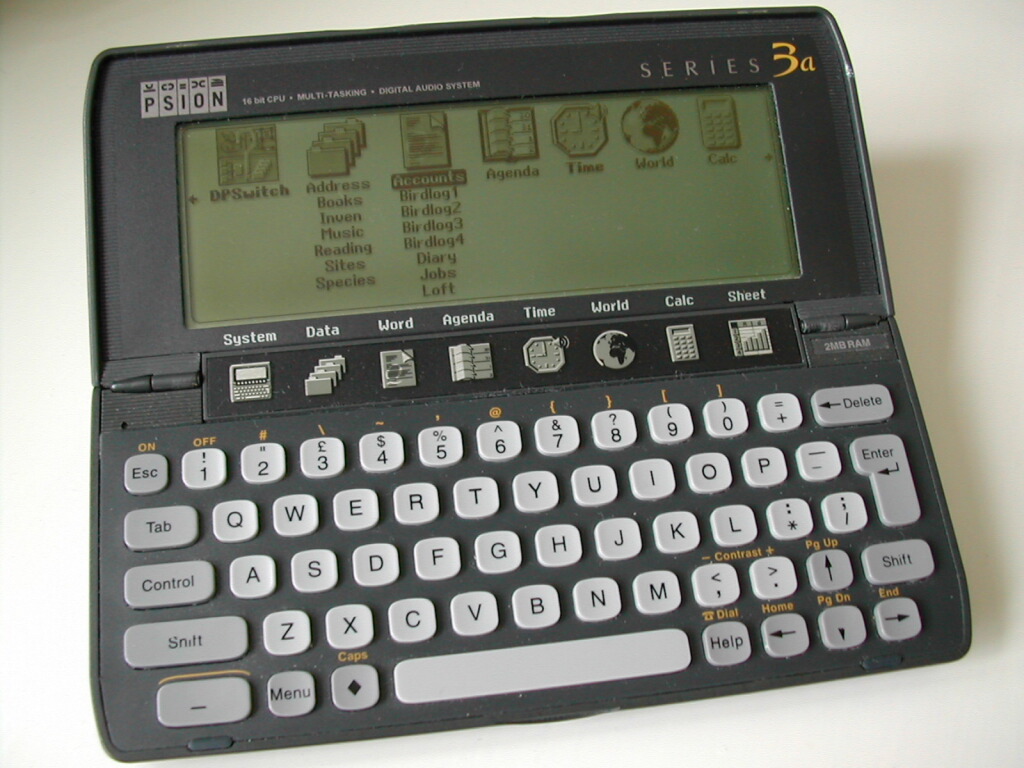
You can see a photo of the Psion 3A pocket computer from the early 1990's above. Of all the computers I have owned over the years, this is the one I miss the most. Small, relatively powerful and with an excellent keyboard, I really wish that I still had it. It was the size of a spectacle case, yet ran MS Word, and interfaced with a full sized printer. I used to use it to write many magazine articles, often whilst sitting in a pub somewhere. I don't think that any modern netbook or mobile computing device has come anywhere near its' combination of long battery life and clever software implementation.

Talking of sci fi, if anyone is keen on obtaining a replica of the original teleport bracelets from Blake's Seven, please get in touch with me; one of my friends is in contact with the person who originally made them for the cult TV show, and has now got a licence to reproduce them for collectors. They are not cheap, but they are an item you can obtain in no other way. A photo below for your information. Get in touch if you are interested.

Young's Brewery are meant to be opening a pub and restaurant inside the Woolwich Arsenal redevelopment; the pub was due to open late last year, but due to the poor state of the economy, it would appear to have been delayed; unlike Kent brewer Shepherd Neame, who stepped up their acquisition of new property in the down turn (properties being cheaper during the recession). Young's would appear to have taken a more cautious approach - a pity as it is an excellent site, and a very good long term investment for them. The number of high earners working in the city or Docklands moving into the secure, gated community who would rather go out for a drink and a meal than eat at home after a long day in the office would seem to be high. I will be writing to Young's for an update on their plans for the place. An opportunity not to be wasted in my opinion.

Here is a story from IT and technical news website The Register: The BBC may axe some of its digital-only radio stations, including 6Music and the Asian Network, according to a report. The Asian Network costs £25m but attracts only 360,000 listeners. It's reckoned to be as expensive per-minute as prime-time TV costume drama. Radio6Music is also under threat as part of a separate review, and despite a higher profile doesn't fare much better, but at 695,000 has gained over the past year. Those numbers may sound like a lot, but DAB-only stations are listened to by just over 3 per cent of the population, and the most popular - usually 6Music - may have only 25,000 listening at anyone time. Hence the reviews. Audience research agency RAJAR published its latest quarterly numbers today, which you can peruse here. And RAJAR reckons "all digital" listening was static quarter-on-quarter - although the agency, owned by the leading radio industry players, doesn't count time-shifting radio consumption, such as podcasts. Ominously, despite a growth in penetration of DAB sets, there isn't a corresponding increase in DAB listening. DAB listening crept up to 13.7 per cent of households from 13.3 per cent quarter-on-quarter, despite half a million more households having a DAB set. Not much point pinning hopes on saving DAB by getting us to send our FM sets to Africa, then, if most people continue to listen to use their DAB sets for listening to FM radio. It's that chicken and egg problem again: axing unique, DAB-only content gives people fewer reasons to migrate to DAB.

Something that winds me up no end is when people use the term "ping" to mean sending an Email. to someone. You do NOT "ping" an email to someone - you SEND it. "Ping" is a technical term to describe sending a TCP / IP information packet over a network, and the subsequent response, often known as a pong. If I hear anyone talking about pinging an Email in future, they are likely to end up wearing a waste paper basket on their head...

Some weeks ago I mentioned a story about an American chap who was making modern laptop versions of classic 1980's 8 - bit computers, including the Commodore 64 and the Atari 800. The machines are equipped with modern hard drives and TFT screens, but otherwise employ the same hardware as the originals.  They are certainly not cheap, as each computer is a bespoke creation that is as much art as it is technology. You can read more about the engineer / artist who creates these amazing one  - off works here.

I would sincerely love an Atari 800 laptop, as the desktop version was my first computer. It takes me way back to the time when I worked in Hatherley Road, Sidcup for pioneering computer dealer Silica Shop.

After a rather turbulent year, it would appear that Bexley CAMRA are back on a firm footing. The fifth Bexley Beer festival is planned - details below for your information.

Bexley’s Fifth Beer Festival
 8th - 10th April 2010

Sidcup Sports Club
Crescent Farm, Sydney Road,
Sidcup DA14 6RA

Souvenir glasses, snacks, Live entertainment Thu / Fri Eve

Admission
Thursday 8 th April 5pm - 11pm £2, CAMRA members £1
Friday 9th April, 11am - 5pm £2, CAMRA members Free
Friday 9th April, 5pm - 11pm £2, CAMRA members £1
Saturday 18th April 11am-11pm £2, CAMRA members £1

Does anyone else think that Swine Flu was the 2010 version of the Millennium Bug? The Swine Flu hotline has apparently been switched off, and the stocks of antidode are being destroyed. One wonders how much money the pharmaceutical companies have made from promoting the scare.

In my opinion, the best closing song from any band that I have experienced - Los Endos from Genesis.