Showing posts with label Kort Propulsion. Show all posts

Sunday, February 05, 2017

New life for The White Hart.


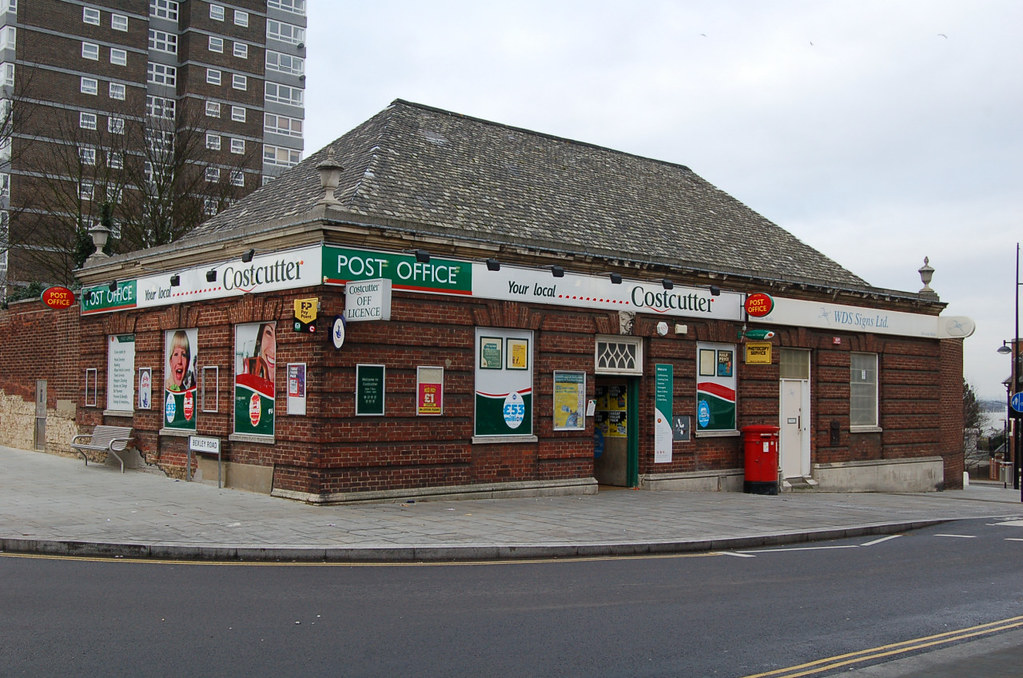
The photo above shows a rather unusual view of Erith Post Office and the adjacent HQ for local company WDS Signs - who make signs for display in public places. The building was originally built as a stables and tack store, but has been in its' current use since well before World War II. In case you were wondering, the photograph was not taken from a drone, rather it was taken from one of the windows in the Cross Keys Centre, which is diagonally opposite, in the Erith High Street Conservation Zone. More on what is going on in the conservation zone later. 

I saw in the news earlier in the week that  former Morrison’s supermarket chairman Sir Ken Morrison had died You can read his obituary in The Guardian here. I had not realised that he was ill. He was aged 85. I met him once, though I did not know who he was until I was told. When Morrison’s opened in Erith back in 1999, I went along for a look on the first day of trading. The place was extremely crowded – I think most of the inhabitants of Erith, Slade Green and Northumberland Heath had come along to check out the mysterious new supermarket that had up to this point been based solely in the North of England, and the Erith store was one of their first forays into the South. I queued up at one of the tills (none of the hated automated, self-service checkouts back then) and paid for my goods. An older man stood at the end of the checkout, and kindly packed my bag for me, I thanked him politely and made to leave the store. I noticed that a number of managerial looking types had been hovering near the chap packing the shopping bags; one of them approached me and asked me if I knew who the bag packers was. I replied that I had no idea, but that the man was pretty good – by this time I had twigged that he was not just a humble bag packer, so was not overly surprised when the person told me that it was Sir Ken Morrison, the billionaire top boss of the supermarket chain, who was visiting on the day of the launch of their flagship Erith store. Small world I suppose, so I was saddened to hear of his demise, albeit at a pretty ripe old age.

A new mini crime wave is hitting the local area; restaurants and takeaways are finding that their containers of waste cooking oil are being stolen. Many food outlets use large quantities of cooking oil, which is usually vegetable based. When it has become contaminated, they store it for collection by specialist cooking oil companies, who pay good money to get hold of the oil. Where’s the money on old cooking oil? I hear you ask; well, it makes excellent bio diesel. There is a general perception that cooking oil needs to be specially treated before it can be used in diesel engines. This is actually not true. You can empty a bottle of Mazola or whatever oil you fancy straight into the fuel tank of your diesel vehicle and it will work a treat. The only thing you need to do with old oil is filter out any particles or bits of food – as these can clog up the fuel injectors of the engine. Old fish frying oil actually smells of the chip shop when you burn it in a diesel engine. Some years ago Mercedes Benz commercial vehicle division did some tests on the use of vegetable oil versus conventional diesel in long term use as a fuel. They found that engines run on vegetable oil actually suffered significantly less wear and tear than those run on conventional diesel – this is not much of a surprise, as Vegetable oil is a lubricant, and diesel is a solvent. Vegetable oil also has far Lower levels of harmful particulates than Diesel, a factor of increasing importance nowadays. Vegetable oil has a lower energy density than diesel, so your miles per gallon does drop a bit, but the cost savings are so big that it makes it worthwhile. It is not illegal to power a road vehicle on chip oil, as long as you have declared it to HM Revenue and Customs, filled in the relevant paperwork and paid the excise duty. Obviously the crooks that are currently nicking cooking oil for use as fuel have no intention of doing that – so if you see some shady looking characters in a van smelling of plaice and chips going past, be very suspicious...

The local press, including the News Shopper and the Bexley Times are reporting something that should not really be very much of a surprise. The are saying that house prices in areas close to the Crossrail development have increased rapidly in price, and cite the example of Abbey Wood, where average house prices have increased by roughly £100,000 in the last ten years. The 73-mile line which will link south east London to Berkshire and Buckinghamshire via central London is expected to open in December 2018. In 2007, the average price of a house in Abbey Wood was £179,482. Now the average price £289,468, a rise 61.28 per cent. The rise is above the average for other houses along what will be called the Elizabeth Line when it opens, and well above the national average increase of 25 per cent.


An announcement was made last week that a couple of new ships are being built to replace the current, fifty three year old Woolwich Ferries. Transport for London (TfL) has signed a contract with Polish shipyard Rementowa Shipyard to build the next-gen vessels following a design by Norwegian firm LMG Marin, working with Hampshire firm Keel Marine Ltd. Two ships (the upper of the two photos above shows a marine architect's impression of the new ferry design - click on the image for a larger version) will replace the three which currently work in rotation. The efficiency and reliability of the new ferries will account for the reduction while the design team have been commissioned to strengthen the service’s “green” credentials, with lower emissions when they come into service next year. The move has been put into place as the current ferries are old and pretty much worn out - there was no ferry service last weekend due to a series of mechanical breakdowns, due mainly to the age and difficulty in obtaining spares for machinery which has not been in production for many years. The new vessels, which will be substantially larger than the current ferries, at 60 metres long, with a capacity of 150 passengers and about 45 vehicles, will be designed with a hybrid diesel-electric propulsion system. The lithium-ion battery pack will optimise the fuel consumption by allowing one engine to charge the batteries when not powering the propulsion. The new ferries will engage an automatic mooring system at the end of each short journey meaning the fuel-heavy thruster units will be practically redundant while specialist catalytic reduction systems, use of ultra low sulphur diesel and LED lights will help boost the ferries’ green credentials. Erith is home to one of the world's premiere marine engineering companies - Kort Propulsion. They are supplying the custom designed propellers for the two new ferries, which are of a LMG Marin 60-DEH design, each one equipped with a set of four Hydromaster Azimuth thrusters rated at 300 kW, driven by vertical mounted permanent magnet motors from a DC grid system. Hydromaster are also a local company, being based in Thurrock, just across the River Thames in Essex. In 2015 Kort were one of the main organisations involved in the construction of The London Titan (the lower of the two images above - click on it for a larger version) - a 36 metre long vessel for the Port of London Authority. The London Titan is designed as a mooring maintenance vessel. Titan is doing much more than just maintain moorings.  She is equipped to: 1) lay and recover navigation buoys; 2) haul wreckage from the bottom of the river; 3) support diving operations; and 4) to undertake small scale plough dredging operations. On a river that is getting busier with passengers and freight, that capability is essential. Already there are over eight million passenger trips on the Thames every year – the Mayor wants to increase that to 12 million by 2020.  A multi-function vessel, London Titan is much better equipped than the nearly 50-year old vessel she replaces. She has been specially designed for the Thames by UK-based naval architects MacDuff Ship Design, working in close collaboration with PLA marine engineers, masters and crews. The Titan is a vessel able to work along virtually all of the PLA’s 95 miles of the tidal Thames for which the PLA is responsible. She is squat and shallow enough to negotiate bridges as far upriver as Richmond, and robust enough to operate in the outer estuary. A sizable chunk of the £7 million cost of the custom – designed ship will have been in the propulsion and steering work that Kort Propulsion undertook. Great news to see that a specialist local firm is not only contributing to the safety of navigation on the River Thames, but is bringing much needed money into the local economy. It just strikes me as appropriate that two very significant components of the new Woolwich ferries are being manufactured locally. Engines from Thurrock and propellers from Erith's own Kort Propulsion

I had quite a response to my piece last week about the freight train derailment at Lewisham, and the deleterious effect that this had on overland trains locally, which in any case have been deteriorating from an already low point over the last year or so. One regular reader called Stephen wrote to me with the following observations:- "I was particularly interested in reading about the derailment at Lewisham, and that you now take the 99 bus and DLR to work. The reason for my email is I also find myself in the same situation as yourself. I personally work in Southwark and to get to work I normally take the 0544hrs B12 bus to Bexleyheath Station and then the 0600 train from there to Waterloo East. I use Bexleyheath station as it costs less being in a different zone.I currently hold a Gold annual season ticket. My gold card expires next week. I have been appalled by the reliability of South Eastern trains over the last 12 month, delays, cancellations, signal failures, broken down trains, derailment at Lewisham and then the train fire at Kidbrooke last week. This year has been the final straw for me with the trains. I have held a Gold Card for 13 years and I will no longer be renewing my season ticket with South Eastern. I know I am not the only person that feels this way! I have also changed to a different mode of transport from next week. I tried last week a different way, which worked well. I will catch the 0525 route 422 bus to North Greenwich and then the Jubilee Line to Southwark. I was really surprised the journey to work is actually quicker by bus and tube. Plus it saves me money overall!! I am only a minority that may be changing travel plans, I just wish many more would do the same and show South Eastern how we have had enough. Sorry to rant on and on, but this has been annoying me for a while". I think that many commuters have been spurred to look for other means of travelling to and from London, and Stephen is far from alone in this respect. I have also heard from a confidential source that the cause of the freight train derailment is pretty much already known, though it cannot be officially published until a full report from the Rail Accident Investigation Branch is completed. My source writes:- "It should be worth noting, that after investigation by the Rail Accident Investigation Branch (RAIB) a number of recent freight train derailments have been caused by poor maintenance of rail wagons. It will take a while to get a full report of why this accident took place, indeed it appears that repairs had taken place at this junction only recently".  Interesting stuff indeed. If it does come to light that the derailment was caused by a lack of preventative maintenance on the freight wagons, this would tend to concur with my own casual observations; on many occasions I have been on a passenger train whilst a freight train passed by; it has not been uncommon for one or more of the freight wagons to have wheels that emit an ear - splitting screech of metal on metal - it sounds as if the wheel bearings are often completely lacking in grease, although we will have to wait until the full and complete RAIB report is published for the accident before we will be in possession of the complete facts.

The second series of BBC TV's "Top Gear" made without Jeremy Clarkson, Richard Hammond and James May is scheduled to start transmission in the next few weeks, though at present the BBC have not yet published a commencement date. After replacement lead presenter Chris Evans left the show after one season of utterly woeful ratings where they started the season on the low side, then promptly went into freefall thereafter, it will be instructive to see how the show will fare now that The Grand Tour has now aired on Amazon Prime. The Grand Tour is basically Top Gear under a new name and with a massively increased budget, and presented by the original "Three Amigos" on web based broadcaster Amazon Prime. I get the feeling that the BBC will have a real challenge to make anything of old Top Gear, now that The Grand Tour has absolutely ridden over it so completely. I think that they have two choices - either re - imagine Top Gear as a completely different car show - perhaps going down the route of making it a serious factual programme about cars, or they admit defeat and cancel it completely. I understand that after the ratings collapse during Chris Evans' tenure, the commercial rate at which the BBC has been able to sell Top Gear to foreign broadcasters has drastically reduced, meaning that they may well be stuck in a vicious circle - lower ratings mean less income, which means less money to spend on a show which at best has around a tenth of the budget of The Grand Tour, and also lacks the charismatic original three presenters. Personally I think the Beeb should pull the plug on Top Gear and walk away with a few shreds of dignity still intact.


I am pleased to say that Erith is currently being converted from the old and energy inefficient sodium incandescent street lights to much more economical and efficient LED lighting. Chief among the advantages of LEDs is that they have extremely long lives -- they don't have filaments that can quickly burn out -- and they don't contain toxic chemicals like mercury, unlike traditional high-pressure sodium lamps or mercury-vapour lamps. An LED light can last 100,000 hours. These lights also have reduced maintenance costs because of their long lives, and they give off less heat than other bulbs. Because they last so long, LEDs are suitable for places where replacing light bulbs is expensive, inconvenient or otherwise difficult. LEDs are highly energy efficient. While compact fluorescent lamps (CFLs) recently have been touted as the standard in green lighting, LEDs actually have double their energy efficiency. They use 15 percent of the energy of an incandescent bulb while generating more light per watt. LEDs produce 80 lumens per watt; traditional streetlights can only muster 58 lumens per watt. Another less well publicised benefit is that LED lights have a clean white light that does not distort colour; one side effect of the old sodium lighting was that it gave an orange / yellow cast to objects that they lit; this had an effect of making the judgement of distance between cars more difficult. LED lighting may actually make for safer roads, as well as saving a huge amount in running costs. The down side of LED street lighting is that it can cause an increase in light pollution, as the light output per Watt of energy is so much higher than with older technologies, but it is generally felt that the benefits far outweigh the down sides. What do you think? Leave a comment below, or Email me at hugh.neal@gmail.com.


Information has finally come to light regarding the redevelopment / refurbishment of the old White Hart / Potion Bar – a subject that has been vexing many locals for a very long time. On Thursday I received a couple of very informative Emails from a lady called Sharon who had uncovered some documents on the Bexley Council Planning website – something that had eluded me for some reason. It turns out that the building is now owned by The Wellington Pub Company – a pub co that specialises in turning around “challenging” pubs in areas that other companies avoid. The official description of the works to be carried out is as follows:- "Conversion of upper floors of Potion Bar into 1 x 2 and 1 x 3 bed flats and the erection of a two storey building plus basement comprising 4 x 1 bed and 2 x 2 bed apartments and 1 x 3 bed duplex with associated parking and amenity space". As you can see above, the plans for a replica frontage to replace the hideous plate glass frontage illegally installed (see the upper photo) against planning laws by the owners of Potion have now been finalised, and are far more detailed and complete than the drawing I published a couple of years ago. The new frontage closely resembles the original (see the lower of the two images above - click on it for a larger version), and will be a massive improvement to the appearance of the historic building. Work on removing the illegal plate glass frontage and installing the replica of the original Victorian design began on Friday, and will continue into next week and most likely beyond. It is about time that the old building got some sympathetic attention, as it has been unloved and ignored for far too long. I can clearly recall the horror I felt when back in 2009 I was standing outside of the corner by Matalan, looking across the road to the White Hart as the criminals from Potion talked to the borough planning officer about the work that they were undertaking. I clearly heard the council official tell the crooks that they were to leave the existing period White Hart pub sign in place, as it had historical and aesthetic significance. Literally moments after the planning officer drove off, one of the Potion workers got out a large angle grinder and cut down the protected sign and threw it into a nearby skip. From this point I knew Erith was in for trouble; sadly I was not wrong. After several years of drug dealing, fights, public drunkenness – and even a visit by Peter Andre, the venue closed after a series of enforcement notices by both Bexley Council and the Metropolitan Police. It was also convenient for the operators of Potion to declare themselves bankrupt, as it absolved them from having to restore the historic building frontage, as per two court orders that they successfully ignored. Strangely no mention is made in the newly available redevelopment documentation of what is planned for the existing bar area - the documents only cover the upper floors and development in what is now the (currently unused) garden of the pub. What the plans for the ground floor bar are, I really don't know. Suggestions were made around eighteen months ago that the ground floor could be converted into an Indian Restaurant, but that turned out to be a dead end - perhaps wishful thinking on someone's part? More recently I have heard rumours that an ice cream / smoothie chain were looking at the ground floor space. I could see this working - after all, you do not need to install lots of expensive and complex fume extraction equipment if you are only serving cool or frozen food. Whilst it would not exactly be to my taste, I could see an ice cream restaurant being popular locally. If you have any additional information, please drop me a line to hugh.neal@gmail.com.

Morrison’s in Erith have been in the local press for all of the wrong reasons last week; As has been widely reported in the News Shopper, a three year old boy was seriously injured in the store after slipping on a transparent vegetable bag which was on the floor. The little boy had extensive injuries, including a badly broken femur. Morrison’s deny responsibility, saying that they check the floor for loose bags and other objects every thirty minutes, as the health and safety legislation requires, and that the bag must have been dropped on the floor between the half hourly checks. To be honest, the bags, which are usually found in the fresh fruit and vegetable area are often dropped on the floor by customers. It is a difficult case – you can read all of the details on the News Shopper website here. I do find that once again, some of the comments left by readers on the story are reprehensible – there are a number of trolls deliberately posting inflammatory stories in the hope of eliciting responses. Quite what motivates people to do this, goodness only knows.

The ending video this week features several layouts at the 2017 Erith Model Railway Society Exhibition, which was held in the main hall at Longfield Academy. See what you think and either leave a comment below, or Email me at hugh.neal@gmail.com.

Sunday, June 28, 2015

The launch of the London Titan.


Visitors to the Erith Riverside Shopping Centre may have noticed recent activity on the former Blockbuster video hire store, which has been empty and unused since the video hire chain went bust back in September 2013. The large retail unit is being converted into a soft play area for small children. The builders have been at work for nearly six weeks now, and the change in use of the store is now becoming apparent. When completed, the place will be called Kassiopi Cove, a pirate themed multi level play area, including a super fast four lane slide, a spiral slide, ball pool with interactive ball lifter, pirate climbing tower and dedicated baby and toddler play areas. The website mentioned on the poster above is not active at present - though the domain is registered. I will be contacting the business owners in the hope to run a more detailed feature on them in the coming weeks.

As I wrote back in November last year, the new toll collection system at the Dartford River Crossing is still receiving a large number of complaints. The new scheme - called Dart Charge - has been in place since November 29th last year. Motorists have no longer had to stop at toll booths to pay for the crossing. Instead, they can pay remotely, either online, on the phone, in certain shops or by post. The idea behind this is that free flowing traffic should move more quickly, as overhead cameras using number plate recognition technology are in place to catch any toll-dodgers who will be issued a fine for non-payment. While the majority of users have a smooth experience, some users have suffered problems with being double charged, or having a payment query, and not being able to get through to the call centre. I am also aware that a considerable number of "ghost journeys" have been reported - where a vehicle is charged for travelling over the crossing, when it was in fact not in the area at the time. There is already a serious problem around the country with false, stolen or cloned vehicle number plates in use by crooks trying to avoid both toll charges and fines for other traffic offences. I know for a fact that in the local area vehicles are illegally on the roads with suspect plates - and the Police are actively investigating those involved; from my understanding, the kind of person who fits false registration plates to a vehicle is the sort of person who is very likely to be involved with other kinds of criminality as well. The Dart Charge system has problems differentiating between "0" and "O", and there have been multiple instances of the wrong person being sent a fine notice. One commenter on the story on the Kent Messenger website wrote:- "My Dad (who lives in Yorkshire and who has never been anywhere near Dartford) just had a penalty notice through. He drives a Volvo V70 yet the car in the photo was a Renault! He rang up to complain but they said he would have to appeal against it! What a waste of time and money!" It is apparent that the Dart Charge system is deeply flawed, and the public are rapidly losing faith in it. Please feel free to leave a comment below; alternatively you can Email me at hugh.neal@gmail.com.

It looks like the UK National Health Service could finally be getting a much needed shake – up in respect to its current public support for homeopathy. At present the NHS spends approximately £4 million a year on homeopathic “medicines”, and £20 million a year on the maintenance and running of the Royal London Hospital for Integrated Medicine. Homeopathy is a two hundred year old pre-scientific system of medicine based upon magical thinking. It is mostly based on two notions, the first of which is that like cures like. In other words, a substance that causes a symptom can cure that symptom in extremely low doses. The NHS Choices website defies homeopathy as “Homeopathy is a complementary or alternative medicine (CAM). This means that homeopathy is different in important ways from treatments that are part of conventional Western medicine. It is based on a series of ideas developed in the 1790s by a German doctor called Samuel Hahnemann.  A central principle of the "treatment" is that "like cures like" – that a substance that causes certain symptoms can also help to remove those symptoms. A second central principle is based around a process of dilution and shaking, called succussion. Practitioners believe that the more a substance is diluted in this way, the greater its power to treat symptoms. Many homeopathic remedies consist of substances that have been diluted many times in water until there is none or almost none of the original substance left. Homeopathy is used to "treat" an extremely wide range of conditions, including physical conditions such as asthma and psychological conditions such as depression.” There is no scientific basis for this, despite the desperate attempts by homeopaths to invoke vaccine-like analogies. The second notion is that you make a remedy more powerful by diluting it to extreme degrees. People have fun making comparisons, such as the need to drink a solar-system’s worth of water to have a 50% chance of getting a single molecule of active ingredient. No problem, say the homeopaths, homeopathic potions contain the magical “essence” of what was previously diluted in them. Homeopaths are also hoist with their own petard when it comes to the evidence. Rigorous clinical trials of homeopathy are frustratingly (but not surprisingly) negative. Homeopaths explain this away by saying that double-blind placebo controlled trials are not really appropriate for homeopathic treatments. Such studies take a cookie-cutter approach to treatment, while real homeopathy individualizes the treatment to the patient. This argument, however, just creates two even more serious problems. The first is that whenever homeopaths use this argument they throw the entire homeopathic industry under the bus. They are essentially saying that all over the counter homeopathic products are useless, and even fraudulent. I would be happy to stipulate to this, and erase the entire over the counter homeopathic product industry. We can then deal with homeopathic practitioners separately. The second problem is the manner in which homeopathic treatments are individualized. This also is not based on any scientific principle or set of reliable empirical data. It’s all magic and witchcraft. Quirky traits, like whether someone is emotionally disturbed, are used to determine their optimal treatment. There is also no consistency among homeopaths – see ten different homeopaths and you may get ten different treatments. This has more in common with an astrological reading than medicine. It is an elaborate system of utter nonsense. Word that homeopathy is complete moonshine is starting to get out. In 2010 the UK House of Commons Science and Technology Committee completed a full report on homeopathy in which they concluded it is witchcraft – that it cannot work, it does not work, and support for homeopathy in the national health service should be completely eliminated. In 2015 the Australian government completed its own review, concluding that there is no evidence that homeopathy works for anything. Homeopathy is a placebo. The sooner the NHS stop paying for it, and use the money for real, scientifically proven medical treatments, the better for us all.


I will be attending Erith Fun Day on the 18th July - look out for me, and do come over to say hello. Apart from meeting Maggot Sandwich readers, I will also be promoting the Friends of Christ Church Erith - the secular organisation that raises funds for, and cares for the historic landmark building. I sit on the committee of the organisation; we are looking to recruit new members. You can have a chat with me about what the Friends are doing, and maybe pick up a leaflet.

My article on the possible future of the Potion Bar / former White Hart has provoked some reader Emails. The general consensus seems to be that the Email authors would quite like a decent local "eat in" curry house, but agree that it is probably wishful thinking at the moment; the investment required on the very down at heel site would just be too high to make it a viable business. I must admit that I have been giving quite a bit of thought, and some online research on the subject of the British Indian Restaurant. There were six 'Indian' restaurants in the whole of Britain in 1939 - three in London (one of which, the Halal in St Mark Street E1, is a former haunt of mine), and one each in Oxford, Cambridge and Manchester. In 2015 there are roughly 8,500. Eighty five percent are Bangladeshi-owned and with mainly Bangladeshi personnel. They have an annual market turnover of £2.5bn, representing a little over ten percent of all restaurant business in UK. There is direct employment at the curry restaurant of over 100,000 personnel. with an indirect additional employment in supply and related industries for a further 50,000 plus. The Bangladeshi run “Indian” restaurant has become a well – loved feature of many British high street - they offer their diners a large and comprehensive range of curries, many of which are of Indian origin, if somewhat modified over time, and engineered to suit local tastes. You will find a number of ‘restaurant favourites’ such as Samosas, Onion Bhaji, Kebabs, Chicken Tikka and its popular derivative Chicken Tikka Masala curry. Other famous curries included Korma, Bhuna, Pasanda, Jalfrezi, Biriani and Pilaf. The have developed a rapid production method for serving their food.  The authentic curries and accompaniments of Bangladesh have much in common with those of Bengal, and indeed the whole of India, the spicing is distinctive and subtle. Beef is the prevalent meat, and duck is popular. Tropical fish and exotic vegetables (now available in the UK from many supermarkets, as well as specialist stores) form an indispensable part of the Bengali/Bangladeshi diet. They use mustard and poppy seed extensively. Their important five spice mixture, Panch Phoron, has differences as subtle as their spelling. For example, in Calcutta, Bengal’s capital, it will include white cumin, fennel, fenugreek, mustard or celery seed and wild onion. In Dhaka, Bangladesh’s capital, celery seed would not be used, but black cumin and aniseed would replace wild onion and fennel. Bangladeshi Garam Masala will, like as not, contain chilli. Surprisingly perhaps, Bangladeshis adore the chilli, and it appears in many forms, in many recipes, not so as to swamp the delicacy of the spicing - rather to punctuate it. Some curries may use as little as three of four spices, and the effect is remarkable. Coriander, turmeric and cassia , for example, are all that is needed to produce the Bangladeshi version of that old favourite, Bhuna, whilst their versions of Korma are creamy and mild. Yet the results are neither tame or bland. Bangladesh has a unique range of curry cooking. Nowhere else on the subcontinent has such an array of tastes - sour, bitter, sweet, hot, savoury, mild, pungent and fragrant. Bangladeshis adore all of these tastes, which they achieve by using tamarind and sour fruits, bitter vegetables, molasses, chillies and uniquely subtle blends of spices. Creamy curries, contrast with dry stir-fries, fluffy rice, with chewy breads. Sometimes cooked with nothing more than garlic with, a sprinkling of whole spice seeds and chilli, these recipes achieve great culinary heights, and are ideal for the health-conscious cook. Many British 'Indian' restaurants operate to a formula which was pioneered in the late 1940s. In those early restaurants, a way had to be found to deliver a variety of curries, without an unreasonable delay, from order to table. Since all authentic Indian recipes require hours of cooking in individual pots, there was no guarantee that they would even be ordered. So cubed meat, chicken or potatoes, dhal and some vegetables were lightly curried and chilled, and a large pot of thick curry gravy, a kind of master stock, was brewed to medium-heat strength. To this day, portion by portion, on demand, these ingredients are reheated by pan-frying them with further spices and flavourings. At its simplest, a Medium Chicken Curry, that benchmark of middle ground, is still on many menus, though sometimes disguised as Masala, and requires no more than a reheat of some gravy with some chicken. For instance, take a typical mixed order for a couple at a table for two. She wants Chicken Korma (fry a little turmeric, coriander and cumin, add six pieces of chicken, add a ladleful of curry gravy, plenty of creamed coconut, almonds maybe and a little cream – result, the additions make it mild and creamy-golden in colour), and with it she'll have Vegetable Dhansak (fry some cumin seeds, dry methi leaves, chopped onions, tomato, red and green bell pepper with the gravy, add dhal and some cooked veg – result, colourful, and still medium-strength). He wants Lamb Korma (as for the chicken recipe, instead using pre – cooked Lamb), and he wants Prawn Vindaloo (fry spices and chilli powder, add the gravy which at once goes red and piquant, then cooked peeled prawns, fresh tomato and potato, simmer and serve). Maybe they will also take a Sag Paneer (fry cumin seeds, some thawed creamed spinach and premade crumbled paneer together, add fresh coriander – and that is it). One cook can knock all these up, simultaneously, in five pans, within minutes. Rice is precooked, breads and tandoori items made to order by a different, usually junior chef.  The order is thus successfully completed.  Thus the menu can be very long, with an almost unlimited variety of dishes, sometimes numbered, sometimes heat-graded, mild, medium and hot, hottest, and any dish is available in lamb, chicken, prawn, king prawn, and most vegetables, too. That is the formula, and its perpetrator is the standard curry house. Just because this is not authentic as you would find in an Indian or Bangladeshi household does not make it bad. It can be, and variously is, done well. If you consult YouTube you will find dozens of videos showing you how to prepare both authentic Indian curries, and also BIR (British Indian Restaurant) curries. Personally I prefer cooking my curries from scratch, using individual spices – I certainly don’t use any pre – prepared cooking sauces, as making it the authentic way is not just a lot tastier, it is also far cheaper too. Below you can see a video showing you how to cook a Chicken Jalfrezi in the British Indian Restaurant style by YouTube curry expert Al in his kitchen.


Since my article last week on the old Erith Library, a little more information has come to light. My informant expanded on their original statement to say that rather than buying the old library, Bexley College had intended to make a joint bid with Resources Plus and the Learning Centre Bexley (formerly Bexley Adult Education) so Bexley College would not have owned the building but they were hoping to be one of the partners delivering training in the newly refurbished centre. Unfortunately the deal came to nothing, and the old library remains empty and unused. I have heard concerns voiced that the old library building is decaying, and that is has severe problems with damp. I still struggle with the reasoning which saw the library move to its new location in the High Street. For me the only reason which seems to hold water is that the old library cost a fortune to heat and light, as it was very energy inefficient. Aside from that, the argument that the location of the old library in Walnut Tree Road was too far from the town centre makes little sense – it is no more than a couple of minutes’ walk at most, and the place was always busy. The new library is also busy, mainly with Bexley College students using the free Wi-Fi to research their studies. As with the empty and closed Potion / White Hart, local rumours regarding the old Library abound. Feedback that I have heard has varied from the site being sold off for housing, turned into a Wetherspoon's pub (not at all impossible, as the pub company specialise in converting large, listed public buildings into pub / restaurant outlets), or that it might be converted into a hotel. All I know for certain is that nothing is set in stone at this time. Some low level maintenance is being undertaken on the empty building - mainly with an aim to prevent any further material degradation. It will be instructive to see what happens to the lovely and historic building. More news as it becomes available.

British Telecom is asking Ofcom to be freed from its obligation to provide ordinary copper wire voice telephone connections across the UK. The telecoms giant would prefer to provide only internet services, and let customers use them for voice calls. The Telegraph reported that BT wants to move "all domestic and business customers to internet-based voice calls within a decade," but is prevented from doing so by Ofcom, which requires it to offer basic voice connections alongside internet ones. Expecting customers to eventually migrate to a portfolio of "all IP" services, including broadband, television, and voice, BT is upping the pressure on Ofcom in anticipation of its once-a-decade review, due later this year. "BT believes all IP services will be used nationwide by 2025 and we think Ofcom's review is an opportunity to roll back obsolete rules in this area to create a level playing field," A spokesperson told the Telegraph. The problem with using I.P connectivity for voice calls is that there are so many competing and incompatible systems - such as WhatsApp, Google Video Chat, Skype, Apple Facetime, Facebook etc are not required to connect their users to rival networks. If BT go ahead with their scheme in its current form, it would lead to the mass fragmentation of Internet Protocol (I.P) based voice systems if the various providers could not be persuaded to allow their proprietary systems to interconnect and share data packets. This story feels like it has some way still to run before a resolution is reached.

Bexley Brewery, based in the Manford Industrial Estate at the Slade Green end of Manor Road is going from strength to strength. They recently released the following announcement:- “Not only did we have a busy brewery shop on Saturday (and thanks to all of you who bought our beers for your dads!), but we also had a visit from East London and City Camra who organise the Pig's Ear Festival in Hackney. We were over the moon to be told earlier in the year that BOB won beer of the festival! There were loads of great beers there so being newbies we were really honoured!” The Bexley Brewery have not been open for a year, yet they already have a clutch of awards on their mantelpiece, and the business seems to be growing already. The brewery regularly opens to the public; you can find details on their website here and their Facebook page here. The Bexley Brewery are very easy to find, even if you are not familiar with the area; their industrial unit is at the base of the famous Erith Wind Turbine, which is a very visible local landmark.


A very interesting series of Emails popped into my inbox earlier this week; they were from David Parsons, the Managing Director of local marine engineering company Kort Propulsion, who are based in the Old Boat House in Erith High Street. David wrote “ I Just thought would give you some news of the PLA VESSEL "London TITAN" - Kort Propulsion has been a major supplier to the new vessel. We have supplied the complete propulsion package for this vessel including stern tubes, shafting, steering gear, nozzles, propellers along with engine cooling box covers, and a  Kort tunnel thruster. It has cost £7M for the new vessel which is 36M in length. It's massive”. The new ship, which has been custom built over the last three years by Manor Marine in Portland, Dorset is designed as a mooring maintenance vessel. Titan will do much more than just maintain moorings.  She will be equipped to: 1) lay and recover navigation buoys; 2) haul wreckage from the bottom of the river; 3) support diving operations; and 4) to undertake small scale plough dredging operations. On a river that is getting busier with passengers and freight, that capability is essential. Already there are over eight million passenger trips on the Thames every year – the Mayor wants to increase that to 12 million by 2020.  A multi-function vessel, London Titan will be much better equipped than the nearly 50-year old vessel she will replace. She has been specially designed for the Thames by UK-based naval architects MacDuff Ship Design, working in close collaboration with PLA marine engineers, masters and crews. The Titan is a vessel able to work along virtually all of the PLA’s 95 miles of the tidal Thames for which the PLA is responsible.  She is squat and shallow enough to negotiate bridges as far upriver as Richmond, and robust enough to operate in the outer estuary. A sizable chunk of the £7 million cost of the custom – designed ship will have been in the propulsion and steering work that Kort Propulsion undertook. Great news to see that a specialist local firm is not only contributing to the safety of navigation on the River Thames, but is bringing much needed money into the local economy. One hears so often of work of this nature being won by Chinese or other far Eastern suppliers; what great news to find out this time it was from on our own doorstep. You can see a video about the creation of the London Titan below. Contact me at hugh.neal@gmail.com.

Sunday, February 01, 2015

Kort Propulsion.


The photo above was taken by me on Friday lunchtime - click on it for a larger version. It shows the Erith Boathouse, home to both Erith Rowing Club, who occupy the ground floor, and also to Kort Propulsion, the world famous marine engineering and consultancy firm whose high tech offices take up the first floor and overlook the River Thames. I had a meeting with Dave Parsons, the Managing Director of Kort Propulsion, along with his Mother Rose, who also works for what is a genuinely independent, local, family run firm that does business worldwide. Kort Propulsion have been operating for around eighty years, and have been based in Erith for quite a while; they were originally based in the Bank Chambers building, close to the bend in Colebrook Street, opposite to the old Blockbuster store (more on that later). About four years ago they moved to their current riverside location, next to the old Erith Police Station, in the building that used to house the River Police unit. Kort Propulsion was originally founded in 1935 in Germany; once war broke out the licence with the German originator was suspended, and after the war the company was established as a purely UK based enterprise. Kort was then owned and operated by R and H Green and Silley Weir, a ship repair company based mainly on the River Thames and in Falmouth. Current owner David Parsons, along with his father Norman Parsons and colleague Malcolm Breeze, had a wide range of experience in marine engineering and production. Kort was subsequently bought out by P and O for several years, until the Parsons family arranged a management buyout of the company. Nowadays David Parsons is the Managing Director, and runs the worldwide business from their Erith riverside headquarters. The company has strong business links in such diverse locations as India, China, Taiwan, Romania, Egypt, Greece, Portugal and Ireland, and is widely regarded as the "Rolls - Royce" of marine engineers. They export their specialist knowledge around the planet - any it is ironic that very few Erith residents are aware of the existence of such a world - class company which exists on their doorstep. There will be a further feature on Kort Propulsion next week. 


The photo above shows the interior of the old Manor Fish Bar in Manor Road Erith, taken almost ten years ago to the week. Click on the photo for a larger view. The classic 1950's marble - effect formica was very easy on the eye, and back then was kept immaculately spotless and clean. More on the fish and chip story shortly. Both the Bexley Times and the News Shopper reported the jailing of the crook who I caught illegally fly – tipping pallets full of rotten bananas in the recycling centre behind Morrison’s supermarket in Erith. Unfortunately both publications got the details of the sentencing wrong; I wrote to both reporters, correcting them, but no updates have yet been forthcoming – it does seem to me that both papers are guilty of “don't let the facts get in the way of a good story”. I have noticed that over the last year or so, the emphasis that the News Shopper places on stories has changed. I suspect a change in editorial policy away from “hard” news, and towards a more tabloid “fluffy animals and human interest” format. Last week the headline on the News Shopper website was “fox photographed eating a discarded kebab”. Not exactly Pullitzer prize winning stuff, I suspect you will agree. Instead they are running a series of articles, one of which is entitled “Nine of the best fish and chip shops in South East London and North Kent”. The only local one is the Frying Pan in Parsonage Manorway, Upper Belvedere. I have not tried the place myself, but the omens are good – not only does the place get a very good write – up in respect of the quality of the cooking, but the shop also scores five out of five on the Scores on the Doors food hygiene rating system. It is a pity that central Erith no longer has a dedicated fish and chip shop. The nearest one is the Pom Pom Fish Bar in Alford Road, just off Fraser Road, well on the way to Upper Belvedere. There used to be a fish and chip shop in Manor Road, which in the late 90’s / Early 00’s was excellent – I used to be a regular customer. Over the years however, it changed hands several times, and with each change, the quality of both service and cooking declined. Eventually a couple of years ago the place closed for good, and the shop was unoccupied for several months. It was then taken over and refurbished, and then re-opened as the King of the Grill kebab and burger bar. It does serve the odd bit of fish, but it is not the same thing. Still, it gets a very creditable four of of five on the Scores on the Doors rating system, and it seems to keep pretty busy.


On the subject of crime, the general perception seems to be that levels of crime are high and the level of “on the ground” policing is down. In reality this is not the case – at least according to the statistics recently published by the Home Office. It turns out that the level of reported crime in the London Borough of Bexley is the joint lowest in Greater London – a distinction shared with the London Borough of Harrow. You can see the breakdown of reported crime levels in the annotated map above – click on it for a larger version. The cynic in me would say that the map only shows the levels of reported crime – not the actual level of crime – and it may well be that people in Bexley just don't think that crimes are worth reporting, and thus the figures are skewed – I really could not say. If you have any insight into this, please drop me a line to hugh.neal@gmail.com.

There seems to be some light at the end of the tunnel as far as the widening of the Bexley Road bridge over the railway adjacent to Erith Station. The project was due to have been undertaken some time ago – all of the roads that meet at the hideous fish roundabout are two lane, but any traffic turning into Bexley road has to filter down into a single lane as it crosses the railway bridge. This choke point causes all sorts of congestion problems, especially at rush hour. Traffic can be seen standing waiting for several hundred yards back along Bronze Age Way when the situation gets really bad. Many local drivers know to avoid the area, especially on a Friday afternoon because of this. Bexley council have managed to secure a nearly £3 million grant from Transport for London to fund a number of local travel initiatives including further “improvements” (I use the word loosely) to Bexleyheath Broadway, work to improve transport connectivity around Slade Green, and work to improve provision of cycle lanes and pavements, along with what I understand to be the long delayed work to widen the road across the aforementioned bridge. You may recall that only a few weeks ago I wrote that I thought that the only way the bridge widening would ever get done would be if TFL put their metaphorical hand in their pocket, as Bexley Council are currently cancelling or closing as many public services in the North of the Borough that they think they can get away with.

Some good news for Erith Riverside Shopping Centre; the long empty unit that was occupied by Blockbuster before they went bankrupt may have a new occupant before much longer. A planning application has been submitted to convert the unit from retail use and into a children’s soft play centre. I am unsure if the application has been submitted by the same company that applied to do the same to one of the never occupied since they were built units directly on the opposite side of the road, facing Erith Health Centre, but the application looks very similar. Whilst I am no expert in such things, it would seem to me that the area could do with such a facility, and anything is better than an empty and dilapidated shop. Another building that has been the subject of speculation is the former White Hart, also known for a relatively brief period as Potion, before the place closed down under a cloud. Locals have seen activity inside the empty building recently, and there has been speculation as to whether squatters had moved in. From my understanding, a private security company does visit the former pub on occasion, and lights are sometimes seen from the first floor function room, which I suspect are connected to a timer. Despite the note on the frontage of the building which states that the property is protected by a security firm, I seriously doubt that anyone is on site for any length of time, as the associated costs would be prohibitive. There has been speculation as to the eventual fate of the White Hart / Potion building. I originally heard vague rumours that it was to be converted into an Indian restaurant, but nothing has appeared on the planning application website, and I now suspect that the rumour was more wish fulfilment than anything concrete. Anyone who buys the place will need to invest a King’s ransom on refurbishing the building, and installing all new facilities – the place had been run into the ground – only the bar area (the part seen by the public) was given a cheap makeover when Potion took the place on. I won't rant on about how they illegally ruined the frontage by ripping out the acid etched glass and locally made green glazed tiled fascia, to be replaced by hideous plate glass, as I have covered this on more than one occasion in the past. Any new owner will have to restore the frontage to very close to the Victorian original – which will also cost a fortune. I know that many property developers would love to get their hands on the site, as it would be an excellent place to build a block of flats with a clear view of the River Thames. The White Hart / Potion is not only a locally listed building, but located in the Erith conservation area, and thus (I hope) immune from such vandalism. Having said that, Bexley Council are so venal and money grabbing that little would surprise me – if a developer came along and offered the right kind of package, it would not be beyond imagination that the building would become de – listed and planning permission granted. Hopefully that is a worst case scenario, and something better for the local area will eventually happen. Time will tell. Other nearby planning applications have been submitted recently, but for reasons which will become adequately clear in due course, I will not mention them now. Suffice to say that a lot of stuff is happening locally, and it is going to be very good indeed, and far more in keeping with both historical and contemporary Erith.

Some people have expressed shock at the midweek announcement that the Tesco store in Picardy Street, Lower Belvedere is to close in March. I have to say that I was not surprised in any way. When Tesco announced the cancellation of the construction of new stores in both Bexleyheath, on the site of the old Bexley council offices, and the proposed new store in Lowfield Street in Dartford – the source of so much bad blood over the last few years, due to well – founded accusations of Tesco “land banking” the proposed site and leaving the road blighted with empty and derelict buildings. I understand that things got so bad that Dartford Council ended up coming up with an ultimatum to Tesco, essentially saying “build on it or lose it”. The Tesco store in Lower Belvedere has never really been that popular, certainly when compared to the well – loved Co-Op that used to occupy the same site. The feedback that I have heard is that Lower Belvedere locals used the Tesco as there was no alternative – for those without cars, and maybe with limited mobility, the small Tesco had a monopoly on trade. That is, until Asda opened across the road, taking over part of the existing B and Q superstore site. As soon as that happened, it was next to inevitable that the expensive and poorly stocked Tesco would fold. I am only surprised that it has taken so long, as I understand the place has been unable to break even for quite some time. I feel sorry for the staff, many of whom were former Co-Op employees who were taken on when Tesco bought the store. I would imagine that some if not all will be able to find employment in Asda, as the store is very successful – I have been told “off the record” that the Lower Belvedere Asda has reduced the volume of trade in the Erith Morrison’s by close to twenty percent, which I can well believe. Competition is benefiting the consumer, though not always the Tesco employee. I wonder if another retailer will take the old Tesco store? I would imagine that no other supermarket chain would want to operate what is essentially a large convenience store so close to a large and very well run Asda – it would make no economic or business sense. What other kind of retailer would be interested I the unit remains to be seen. I would not wish to see the building standing empty for any period of time. What do you think? Leave a comment below, or Email me at hugh.neal@gmail.com.


Bexley Neighbourhood Watch recently made the following announcement:- Thamesmead could be in with a chance of winning £900k thanks to the Mayor of London's Big Green Fund, but we need your help! Peabody, along with Royal Borough of Greenwich and Sustrans has put forward a stretch of the Thames Path in Thamesmead to a public vote, to canvas support and win funding to help the area reach its full potential of becoming a bustling route for commuters, walkers and cyclists with fantastic views of the river. It would also make a fantastic spot for local residents to get out and enjoy, as well as improving access along the river. However, some sections of the path need improving, in particular to make it passable during winter. The Thamesmead Thames Path Transformation project would enhance the pathway and also create designated look out points along the river; mini green havens with seating and information on the rich local wildlife, habitats and history of the Thames. The proposed scheme is competing with seven others for a slice of the money. We know how passionate residents are about Thamesmead, why not show it by voting here.

A horse has been rescued from marshland this week, following the death of a foal last week which was reported in the News Shopper. On Thursday a horse was found up its neck in water on the Slade Green Marshes, just off Moat Lane. Unlike the previous rescue where the animal died of exposure and hypothermia, the adult horse survived and was treated by a vet. Horses have been grazed and housed on Slade Green Marshes for hundreds of years, and periodically incidents of this nature are reported. From my understanding the horse in question was owned by a responsible person, and it managed to escape the enclosure it was housed in. This seems to be the exception, rather than the rule though; most ponies and horses in the local area are “fly grazed”, and in some cases completely abandoned (an offence under Section 9 of the Animal Welfare Act 2006, and the Animals Act 1971). The problem, as I have previously outlined, is that these animals have no intrinsic value, and cost a lot to look after properly. My observation last week that if Britons started to eat horse meat, it would have the effect of creating value in the animals, and thus mean that they would be far more likely to be looked after in a responsible way was not intended as a controversial talking point, but as a serious but pragmatic solution to an ongoing problem. We are going to see more incidents of the nature described above, unless some drastic changes are put in place.


Another local organisation in the news are the Friends of Christ Church Erith (FOCCE); a secular group dedicated to maintaining the fabric of the Grade 2* listed building located on the junction of Bexley Road and Victoria Road, Erith, within sight of the hideous fish roundabout. FOCCE aims to promote the church and hall as a centre of the community, and as a social resource for those of all faiths and none. It also aims to preserve the historic building and raise money for maintenance and improvements to the available facilities. Christ Church provides a vital social service to the area in a very practical way; it co – runs the Bexley Food Bank in conjunction with the Queen Street Baptist Church, the Trussel Trust, St. John's Erith, and plenty of local volunteers. The Friends of Christ Church Erith are currently recruiting new members. If you would be interested in joining this very worthwhile organisation, you can click here to see how you can get involved. Membership is £10 a year for an individual, and £15 a year for a couple. Corporate members are also sought – the membership for companies and other organisations is a very reasonable £50 a year.


Something that Maggot Sandwich readers may find of interest:- St. Augustine's Church (Slade Green Road, Slade Green, Erith, DA8 2HX) are hosting a Choral Concert by an a cappella choir 'The Ensemble of Friends' and a barbershop quartet 'Double Take' at 7pm on Saturday 7th February.   The conductor and director is Douglas Coombes (who has been awarded an MBE for his services to music). Douglas appears on television and contributes to programmes such as Songs of Praise, and he broadcasts a regular music programme on local radio.   The last 'gig' for the choir was the annual Barnardo's concert at St. Paul's Cathedral ! There are still some tickets available (£4 each, pay at the door, refreshments are included). It will certainly be a different way to spend a Saturday evening.

The construction of the Crossrail terminus at Abbey Wood is now proceeding apace; fellow local Blogger Malcolm Knight of Bexley is Bonkers regularly covers the work, complete with photographs. Crossrail will provide a vital new means of travelling around Greater London and the surrounding counties. The impact on the use of the North Kent Line may well be to substantially reduce the number of passengers – this is also in view of the report this week from the News Shopper, who state that Southeastern Trains have the worst customer satisfaction rating of any train company in the United Kingdom. The News Shopper reports that the National Rail Survey questioned 27,000 passengers last year, and Southeastern was bottom of the list with just 74 per cent of people satisfied - an 11 per cent drop compared to the previous year The company - which recently had its franchise renewed to general astonishment - ranked lower than any other UK train operator. The survey figures also show a gradual rise in the number of delays and cancellations on Southeastern services over the past twelve months. Customers highlighted a lack of sufficient room to sit or stand on the company's trains, and dissatisfaction with staff availability the way the company deals with delays. All in all a very poor performance indeed. How Southeastern got their franchise renewed is beyond me. If any reader has any insight into the situation, please drop me a line to hugh.neal@gmail.com.

The end video this week is a real treat; it show the workshop and stores used by "Mythbusters" presenter Adam Savage, who when he is not presenting the TV show is a real life Hollywood movie prop - maker. Do give it a watch and see what you think.

Sunday, July 06, 2014

Bridge or Tunnel?


I took the photo above last week whilst out one evening with my camera. I was amazed to see a young adult fox on the roof of the Vinton Metals warehouse, off Manor Road. The photo shows the fox reacting to the sound of my camera's shutter. The animal was scruffy and quite possibly suffering from Mange. It stayed on the roof for around five minutes before disappearing from view. Foxes in the local area have become almost completely indifferent to people; I saw a fox (it may have even been the same one as in the picture) on the footpath a couple of weeks ago. It had been going through a dustbin bag put out for collection. I moved toward it, expecting it to run off, but it just sat there watching me with evident curiosity. I then saw it again on Thursday evening when it was sitting on top of a wheelie bin, no doubt trying to get inside. It has absolutely no fear at all. 

The debate about the possible new cross Thames bridge in South East London drags on. After doing some research, I was astonished to discover that plans have existed in one form or another since 1943, where it was due to form part of the post war London regeneration plan. Then it was seriously proposed in 1979, before being subjected to a lengthy public inquiry, redesigned, subjected to a further inquiry, approved in 1991, cancelled in 1993, revived in 2002, subjected to another inquiry in 2005 – and finally cancelled again in 2008, after pressure from the London Borough of Bexley, who were concerned that there was no provision for improving the road infrastructure on the South side of the bridge to prevent serious congestion. If you look at London as a whole (in essence Greater London already functions as a semi independent state) there are twenty two road and rail crossings to the West of Tower Bridge, and only two to the East – the Rotherhithe and Blackwall tunnels (the Dartford QE2 tunnel and bridge do not count as they are outside Greater London). Bearing in mind that more than fifty percent of the population lives to the East, and a majority of the growth in both housing and jobs is going to come in the future, it seems curious that so little priority seems to have been given to improvements in communications to the East. There are practical problems; as the river travels eastwards, it becomes far wider as it heads towards the Thames Estuary. Any crossing will by nature have to be larger and more expensive than those in the West. This is one of the reasons I recently suggested a runnel crossing between Rainham and Lower Belvedere as an alternative to a bridge between Beckton and Thamesmead at Gallions reach, which seems to be the solution favoured by most of the current group of decision makers. Personally I think the Gallions Reach option is a poor one; whilst the Beckton side of the river is mostly a brown field site, with old factories and other structures which could easily be demolished to make way for bridge approach roads, the same cannot be said of the Thamesmead side – where a large and well established housing estate and residential nursing home are situated. It is evident to me that the planners of the Gallions Reach bridge have not spent any time in the area that the proposed structure will affect, or they would be aware of the unsuitability of the solution they propose. Studies have been carried out as the negative impact that additional traffic coming up Knee Hill in Abbey Wood – a narrow road through Abbey Wood that struggles with anything larger than a small car, yet carries HGV’s in a constant stream, which would only get worse with traffic from a proposed bridge. The areas surrounding Knee Hill would also have their own problems – Wickham Lane in Welling is already heavily congested, which would only get worse, as would the side streets which extra traffic would no doubt use as a “rat run”. There would be additional air pollution on top of any increased congestion levels. If this was not enough, any new bridge would need to be high to allow ships underneath, both to the new cruise terminal adjacent to the O2 Arena, and to the Pool of London. If a bridge had sufficient air draught to allow large vessels to fit underneath, it would also need to have very long approach roads to avoid a too steep gradient during the climb up and down from the cross – river bridge span. Conversely my proposed tunnel would have none of those restrictions, and would connect the A13 in South Essex with the A2, and the South Circular in Kent. I feel that other crossings on the East of London will also be required, especially with the creation of Ebbsfleet Garden City (or whatever name the scheme finally gets given) and the Paramount theme park. It seems as if my outline plan for the “Arthur Pewty Memorial Tunnel” (image here) between Rainham in Essex and Lower Belvedere in Kent have at least been in part listened to by the civic planners. On Wednesday an announcement was made that a formal proposal for a road bridge between the two towns was to be launched by Transport for London, in addition to the Beckton / Thamesmead one, as previously described. TfL’s argument is that having two new river crossings would mean that the volume of traffic over each would be reduced, relieving any potential local congestion problems. My concern is that the river is very wide at Lower Belvedere, and any bridge built there would need to be high, long and consequently very expensive. I am still of the opinion that my tunnel proposal is a superior solution. Please feel free to leave your comments below, or Email me privately to hugh.neal@gmail.com. I just hope that planning consent does not take over seventy years like the current scheme already has.

The cinema industry is starting to get very nervous about the forthcoming Google Glass wearable computer. Vue Cinemas and the Cinema Exhibitor’s Association had bilaterally announced that Google Glass wearers will be banned from their cinemas. They have concerns that the camera in the Google Glass headset will be used to pirate movies by recording them from the screen. They seem to have overlooked the fact that the current version of Google Glass can only record 720p video for a maximum of around 45 minutes, and is thus incapable of recording an entire movie, and even then not in true high definition. They also have a “recording in progress” light which fairly blatantly shows observers what the Glass wearer is doing. I understand the wariness of the cinemas though; the technology being showcased in the current prototype version will be upgraded to increase the devices’ capability before the proper commercial launch; I would not be at all surprised if the actual production version of Google Glass bypasses 1080 HD, and goes directly to 4K resolution. This would be a genuine boon to potential pirates, though any films recorded in this manner would still be as obviously low quality, wobbly and pirated as the current ones readily available on dodgy DVD on Morrison’s car park in Thamesmead from the Chinese pirate DVD sellers. To be honest I think there is just as much resistance to the cinema industry to new, potentially disruptive technology they neither understand or want.

A story from the News Shopper caught my attention this week;  a lady called Michelle Roberts got sent  down for three and a half years for a range of thefts, including from her own relatives at her Uncle’s funeral in Southend in 2011, and from other friends and well wishers when she fraudulently claimed that her son had cancer so that she could obtain money for his treatment. You can read the story here. Many readers think she only got six months in prison, but the judge sentenced her to six months for each offence, which are to run concurrently. What this news article does not say is that I used to know her when she worked at the Gallions View Nursing Home in Thamesmead, where my Dad spent the last six and a half years of his life. She was a care assistant there, and to be honest she was not bad; we certainly would not have taken her for a habitual thief and liar. I notice in the photo the News Shopper use, Roberts has a stethoscope around her neck. This must have just been a pose, as she was not a qualified nurse, or even a senior member of the carers. Knowing the Gallions View team as a whole, I am sure that they will be horrified at the news that a former employee could turn out to be such a nasty and dishonest piece of work.


Regular readers may be aware that I run an occasional feature on independent local businesses, and how their work benefits the economy. This week I have received an Email from Dave Parsons, the boss of Kort Propulsion – a world famous and long established marine engineering company that are based in the old River Police station in Erith High street, right on the river front. The Email contained a press release concerning a large export order the company have recently won:- "Kort Propulsion receives order for further 28 x 7.5M RAMEWC Tugboats in Egypt. Kort Propulsion has received an order for the second batch of twenty eight Tug boats for the Egyptian Army. The 7.5M RAMEWC tug boat which has a requirement of 8 Knots and 2.3T Bollard Pull. The first fourteen recently completed by Kort exceeded the Egyptian Armies expectations and requirements. We are delighted to receive this positive feedback and the new order, it secures the future expansion plans of Kort Propulsion. Managing Director David Parsons comments "For the past 6 years we have been working on this project which started with an order for 1 Tugboat, Fourteen more in 2012, and now the quantity is increasing to Twenty eight. This new order well into 7 figures gives the platform for further growth in the company. "This is a special day and a mile stone for the company, my late Father Norman who started this project back in 2008 will be very proud of what we have achieved in such a small period of time. We are continuing his 40+ years of service to Kort and proving we can continue in his footsteps for many years to come." This new order for Twenty eight boat sets from Alexandria Shipyard will consist of Deutz Air Cooled Engines, ZF Gearboxes, Shafting, Propellers, Kort Nozzle Rudders, Steering Gear, all of the Fenders on board, Electrical Controls, and switchboards. Alignment and commissioning will be carried out by Chock Design UK in Alexandria, Chock Design was acquired by Kort Propulsion in 2013 and helps strengthen the group, this company specialise in mounting and alignment of rotating machinery, it also has the distribution rights to the RotaChock adjustable mounting product which are being used in the mounting of the prime movers in this project. "With further quantities due in 2015, this provides a great platform to build on our success in previous years. It's exciting times ahead for the company. We have added new members to our team with Naval Architects in our design office and another member of family to the team. Ann- Marie Parsons, will be looking after the marketing and image of the company moving forward. A new website will be launched within the next 2 months to show the continued growth." Interesting stuff indeed. When Dave has returned from his annual holiday, I hope to visit their offices to interview him and his staff, and to compile a feature on the well known and long established independent local company.


Last week I covered the new Bexley College campus on the piece of land between Walnut Tree Road and Stonewood Road, which is getting close to completion, and is scheduled to open in September for the new academic year. Whilst I was being shown around by Principal Danny Ridgeway and Deputy Principal Martin Peat, we discussed some of the archaeological finds that had been unearthed on the site before construction of the new college building began. I was very surprised when they told me that the foundations of the original Erith Swimming Baths had been unearthed; I was aware of the original baths, but erroneously thought that they were located on the opposite side of Walnut Tree Road, adjacent to the old and currently unused Carnegie gifted library building. Actually the baths were sited in Stonewood road, which back in the day was known as Station Road. If you click on the vintage photo above, which dates back to 1908 you can see that the baths were little more than a tin shack with an open roof, right next door to the old Erith tram shed; from the original ordnance survey plans, one can see that the baths were opposite a large coal yard, and very close to cattle pens that at the time existed outside of Erith Station. There was also an electricity generating station where the current substation exists, next to the old library, and the smoke from the boilers would have added to the whiff. The place must have reeked – and I would have thought it would be used more by the working man than by the local gentry. The photo shows some kind of special event, possibly involving a game of Water Polo, which was then becoming popular, after the sport made its first Olympic appearance in 1900. I think the aristocratic looking lady and gentleman standing on the poolside to the centre left of the picture are John Parish and his wife. Parish was a wealthy local businessman who owned several enterprises in the local area, including Erith Ballast pit and the accompanying riverside wharf. You can read more about John Parish here. what is tragic about the photograph is that many of the young men featured in the picture would not have survived the First World War, which took place only six years later.


Residents in and around Manor Road have learned with dismay that their inconvenience is going to last longer than they were originally informed. The large scale re – engineering of the main road, which had planned to be shut to traffic for ten weeks has slipped by a further week, only eleven days after the work began. Residents have not actually been informed of the change in plans, the only way they discovered that things were progressing more slowly than anticipated was that hand written notices that had been spray painted on the old road surface on the section between Londis and Frobisher Road which had read “No parking from 3/7/14" were hastily re – written to say “No parking from 8/7/14". It would seem that the new road surface is being laid at a slower rate than was expected. Residents were told that a liaison officer from the surfacing contractor would be available to answer questions, but little evidence of such a person has been seen. The fundamental re-engineering of Manor Road is vital to the economy of the area, and I suppose a little pain now should lead to a lot of gain later – it is just a pity that communications between the contractor F.M Conway and residents are not better.

This week Samsung announced that they would be ceasing production of plasma screen TV’s by the end of this year. A lot of film and sports fans are very keen on plasma technology, as it offers screen images with very deep blacks and almost imperceptible motion blur. The downside to plasma technology is that it uses a relatively large amount of electricity, and the screens can run very hot. This is not a major issue for commercial users – you will often see very large plasma displays used in offices, where they are often inset into meeting room walls. They have become less popular for home use, however, where LED and LCD technology has been improving steadily, to the point where picture quality differences are now minimal. On top of that, the newer technologies consume far less power, and consequently run at a lower temperature. To cap it all, plasma TV’s can be made in resolutions higher than 1080i, but they are very difficult to make reliably at full 4K resolution (the old spectre of “dead pixels” returns as the pixel density increases exponentially between HD and 4K resolutions).  Plasma televisions tend to be substantially thicker that LED screens – something that is a major factor for many buyers, who want the thinnest possible television in their living rooms. As I wrote last week, now is really not the time to be shelling out a large wodge of cash on a new television – the technology is in too much flux right now. Better to spend a small amount on a cheap and cheerful HD TV and save your cash for when 4K TV has matured to the point when the big broadcasters are actually providing 4K programming before investing in a 4K television, which will also have the benefit of having dropped considerably in price. I recall when I first saw a flat screen television in John Lewis at Bluewater. It had a 42” screen and was about five inches thick – and it cost £12,000! Nowadays a telly a quarter of the thickness would be about three hundred quid; the same will happen with 4K, even if the first sets have not been quite so eye wateringly expensive as the very first HD ones were.

A team from Exeter University led by Doctor Fiona Matthews recently published a report:- "The Effect Of Mobile Telephones On Sperm Quality: A Systematic Review And Meta-analysis”  in the journal Environment International. The team of academic researchers have been studying the effects of microwave radio frequency energy from mobile phones on the production of sperm.  Many men carry mobile phones in their trouser pockets, and the team were keen to discover if this could be a contributory factor in the increase in male infertility in the last twenty years or so. Currently around fourteen percent of couples in developed countries have problems in conceiving a child, and mobile phone radiation may be a contributory factor. The University of Exeter team discovered that in normal conditions between fifty to eighty percent of sperm are healthy and viable, but that this falls by a little over eight percent where they have been exposed to microwaves on the same frequency as used by mobile phones. Dr Mathews said: "Given the enormous scale of mobile phone use around the world, the potential role of this environmental exposure needs to be clarified. This study strongly suggests that being exposed to radio-frequency electromagnetic radiation from carrying mobiles in trouser pockets negatively affects sperm quality. This could be particularly important for men already on the borderline of infertility, and further research is required to determine the full clinical implications for the general population." Certainly a cause for concern. You can read the full, extremely detailed and technical report by clicking here.

Long time Maggot Sandwich reader Brian Silk (who is also webmaster of the Erith Town website) is also the Manager of local amateur football club Bexley Invicta. They recently won the Aslie Pitter MBE Trophy after winning 4-2 against Bexley Police F.C. at the Thamesmead Town ground in Bayliss Avenue in front of a crowd of more than a hundred people including local MP Teresa Pearce and Aslie Pitter himself. The Aslie Pitter MBE Trophy is named after a chap who first raised the subject of homophobia in football after playing in the late 1980’s for Sutton United and later Clapham Old Boys; when a fellow team  mate discovered that Pitter was gay, he got dropped from the first to the fourth team the very next day by the manager. He realised he was never going to be accepted just for his footballing talent and quit the team. By 1991 Pitter had set up Stonewall FC – the first gay football team in the UK.  Today Stonewall FC has grown to sixty players, and they field three teams, playing home games at Barn Elms playing fields in Barnes, West London. Aslie still plays for and manages the second team. "Today there are five other gay teams in England so we're no longer unique. But with all that we've been through, from some colleagues dying of Aids to others meeting their life partners, the club has become an extended family, and more than a football club." Bexley Invicta are an inclusive football club with both straight and gay players, and are keen to fight homophobia in the game. Bexley Invicta play their home matches at the Northumberland Heath Recreation Ground. If you would like to know more about the local club, you can visit their website by clicking here. Please feel free to comment below. Brian is also a talented amateur musician - here is the video for his latest song.