Showing posts with label The Running Horses. Show all posts

Sunday, March 05, 2017

All natural?


Erith Town Centre currently only has one pub, and that is one that is sadly a shadow of its former self. The Running Horses is in a fantastic location opposite the excellent Erith Riverside Gardens, and overlooking the River Thames. Under previous ownership back in the 1980’s, The Running Horses Carvery was incredibly popular – to book on a Sunday you usually had to make a reservation a couple of weeks in advance. The food was well cooked and plentiful, the place was packed and the service was great. The excellent view over the River Thames from the upper floors windows only added to the whole experience. I can recall being taken there with my sister by my parents on many occasions. It was always a very pleasant way to spend a Sunday afternoon. Unfortunately things have gone downhill since. The Running Horses used to be a “treat” destination, but nowadays it seems to be the last refuge of the desperate. The current owners spent a lot of money on the place a few years ago, but I don’t think they have recouped it. Walking past the place early on a Sunday afternoon, I rarely see more than a couple of cars in the car park at the back, or in the Riverside Gardens parking spaces at the front of the pub. This contrasts with the eighties, when a driver would be hard pressed to find a space after midday.  What the solution for this is I don’t know. Apart from the Mambocino coffee house and cafe in the Erith Riverside Shopping Centre, and the recently opened and very popular Riverside Fish and Steak restaurant, there are no other “sit down” eateries in the town (I refuse to count Morrison’s cafe, as it is not the sort of place that you can make a reservation). So The Running Horses does not have any direct competition, but it still is not doing very well.  All I can say is that it has a couple of issues: 1) Lack of publicity – many don’t know the carvery / restaurant still exists - and indeed it is now rarely open from what I have been told. An advertising campaign or even a FaceBook page might help in this regard, as their website appears abandoned. 2) A concentration on quality of food and drink. When I last visited The Running Horses a couple of years ago, the only real ale they had on tap was Young’s Bitter (one of my favourite bog standard bitters) but it was sour and off. When I took back the pint the barman denied it was off, and when I showed him my CAMRA membership card, he offered me a pint of Carlsberg lager in replacement. I am pretty sure he had no idea how insulting that was to a real ale enthusiast, so I got a refund and went home. This is no kind of customer service. I think a change of management company or brewery might be the best way forward to keep the place going – or indeed as has been mooted, that the place is taken over and refurbished by Wetherspoons. This option seems to be more likely now that the Carnegie gifted library in Walnut Tree Road is no longer available (more on this in the weeks to come).


It is not very often that a local restaurant gets extensive coverage in the press, let alone wins a regional award. The News Shopper have reported that Bexleyheath based Turkish restaurant The Meze, located at the junction of the Broadway and Lion Road has won the award for the best kebab restaurant in South and East London – a not inconsiderable accolade for a part of town that is better known for takeaways than for sit in restaurants. I do wonder, however, what criteria the judges use when deciding who to award the best restaurant prize to, as there are serious concerns about the hygiene practices employed in the kitchens of The Meze, and currently the “Scores on the Doors” star rating only grants the restaurant a one out of a possible five stars for food hygiene. The last Environmental Health inspection of The Meze took place on the 12th January 2017, and the examination found that food hygiene and safety was poor, structural compliance was poor and there was little confidence in management.  This really does not bode well – especially as throughout the London Borough of Bexley the levels of restaurant food hygiene have improved markedly over the last couple of years – you really have to be running a duff operation to merit a one out of five stars. I feel that if I was judging a restaurant in any form of competition, I would certainly take into account how likely any customer was to end up with food poisoning if they visited. What do you think? Leave a comment below, or Email me at hugh.neal@gmail.com.

You may well recall my observations and thoughts on the government's ill conceived plans to roll out smart energy meters to all of the UK by 2020, despite the huge cost and the miniscule actual per household saving the meters will actually bring, not to mention the very considerable risk of malicious hacking that the poorly designed devices expose their owners to. You may have seen recently that the BBC News website was reporting a story that smart meters made and supplied by company SSE have been malfunctioning and showing that their owners owe thousands of pounds when they should have read only tens - you can see the account here. As I wrote back in September, the predicted net energy bill cost saving per household was £23 a year, with the entire smart meter programme costing taxpayers £11bn. The government hopes to get 53 million meters installed by 2020, though just under four million had been installed as of late last year. A decade old Cabinet Office review of the smart meter programme, was unable to pinpoint the financial benefits of the smart meter programme, noting only the cost-benefit impact assessments made at the time varied between a net cost of £4.5bn and a £7.1bn net benefit to the economy. The same report claimed that smart meters “by 2020 will deliver a net annual saving of £23” per dual fuel household. The per-household cost given to the Cabinet Office at the time was an extra £390 for smart meters, against €150 per household in France when that country rolled out its own Linky smart meters. Dan Lewis of the Institute of Directors said in a recent interview:- “The government’s poorly thought-out smart meters programme has stifled innovation, competition and consumer choice driving the final cost to the customer up. It started costing £7bn and we are now looking at over £11bn. This programme needs to be opened up to much cheaper alternative emerging smart energy solutions. Only when utilities have to sell the technology to consumers and are prepared to return most rather than some of the benefits, can the cost of the programme be brought under control".


Further with the food theme:- there has been much in the press over the years in regard of the quality of ingredients used in fast food meals; most of the big players such as McDonald’s to their credit have improved in the quality and provenance of their meat and eggs for example. All of the companies are acutely aware that their public image and their credibility is dependent on their customers having confidence in their products. One such company is Subway, who foster an image of being a more health conscious option than some of their competitors such as KFC. It would appear that in some countries at least, the quality and healthiness of Subway meals is now being called into question. A study recently undertaken in Canada has shown that what is being marketed as chicken by Subway is rather less than is being claimed. In an investigation undertaken by the Canadian Broadcasting Corporation, samples of chicken meat were taken from a number of fast food outlets, and then genetically tested to find out exactly how much chicken each sample actually included. The results made for interesting reading. McDonald's Country Chicken-Grilled was 84.9 percent chicken, Wendy's Grilled Chicken Sandwich 88.5 percent, A and W's Chicken Grill Deluxe 89.4 percent, and Tim Horton's Chipotle Chicken Grilled Wrap 86.5 percent. Meanwhile, Subway's Oven Roasted Chicken Sandwich (53.6 percent chicken) and Sweet Onion Chicken Teriyaki (42.8 percent) seemed to be only half chicken. So what was the "alternative chicken" mixed with the real chicken in these sandwiches? Mostly soya protein, according to the testing performed by the DNA researcher. But soya protein was not the only thing mixed with the chicken. The CBC report explained that the chicken in the six sandwiches included a total of fifty different ingredients (each chicken piece averaged 16 ingredients), ranging from honey and onion powder to industrial ingredients. I have to say that I am not actually surprised.  I cannot say for sure how accurate the testing may have been given that the results have not yet been published in a scientific journal. However, using less expensive fillers or "alternative meat" to bulk up real meat and enhance taste is not a new practice. Previous reports have found a number of other ingredients mixed with meat in tacos and different sandwiches such as wood pulp. To explain, Burger King, McDonald’s and other fast food companies list in the ingredients of several of their foods, microcrystalline cellulose (MCC) or “powdered cellulose” as components of their menu items. Or, in plain English, wood pulp. The emulsion-stabilizing, cling-improving, anti-caking substance operates under multiple aliases, ranging from powdered cellulose to cellulose powder to methyl cellulose to cellulose gum. The entrance of this non-absorbable fibre into fast food ingredients has been stealthy, yet widespread: The compound can now be found in buns, cheeses, sauces, cakes, shakes, rolls, fries, onion rings, smoothies, meats—basically everything. The cost effectiveness of this filler has pushed many chains to use progressively less chicken in their “chicken” and cream in their “ice cream.” McDonald’s ranks highest on the list with cellulose integrated into 14 of their menu items including their renowned fish fillets, chicken strips and biscuits, with Burger King ranking second on the list with 13 menu items containing cellulose. Moreover, many cellulose-laden ingredients (such as honey mustard, bbq sauce, and cheese blends) can be found in multiple items throughout the menu making the filler difficult to avoid. It is best understood that all of the large chain fast food outlets skirt around food description laws by using seemingly innocuous phrases such as “all natural” which is meaningless – after all, crude oil and Uranium are natural products, but you would not want them anywhere near your food. What do you think? Leave a comment below, or Email me at hugh.neal@gmail.com.


Now that the final plans for the refurbishment and rebuilding of the White Hart / former Potion bar have been published, it would seem that the intention to build a series of flats on the current site of the pub garden have been somewhat curtailed. The new plans are more in keeping with the location, and the fact that the main pub building is located within a conservation area. You can see drawings showing the revised plans for the new building work above - click for a larger version. Providing the work is carried out to a high standard, I am hopeful that the end result will be a real asset to the local area. The replica of the original Victorian acid etched glass, wood and green glazed tile frontage is currently being constructed, and work would appear to be progressing well. Once the reconstruction work is completed, the building should look very similar to how it did prior to the extensive and illegal vandalism carried out by the former Potion owners when they criminally destroyed the listed pub frontage and installed a horrible anachronistic plate glass frontage that was totally out of place. The Spring and Summer of 2017 will see some big changes happen in and around Erith. Work is already under way on the new housing development on the site of the old Riverside Swimming Baths site on the corner of Walnut Tree Road and Erith High Street. The Exchange will be taking over the nearby former Carnegie Library, and restoration work has recently begun on the White Hart – where the upper floors will be converted into a couple of flats, and the garden will be replaced with some low level retirement apartments overlooking the River Thames. Word reaches me that the remaining vacant units adjacent to the Fit4Less gym is under offer from a potential new tenant, meaning that at long last the building will finally have full occupancy. On top of this, down on Fraser Road, the first phase of Erith Quarry will be completed by the end of the summer. The whole town is progressively being regenerated; one only needs to consider how much has changed in only the last year to understand the scope of the transformations – which are most certainly for the better.


Last Saturday I was down in Gravesend on a search for a new chair for my home office - more on this later; the current chair is literally falling to pieces and really needs to be replaced with something more suitable sooner, rather than later. Whilst travelling along West Street, which runs parallel with the River Thames, I could see a large red lightship moored on a metal jetty, which you can see in the photo above, courtesy of fellow blogger and journalist Cathy FitzGerald - click on the photo for a larger view. After doing some research, I discovered that the ship was actually the historic former Trinity House Light Vessel 21, usually referred to as LV21. The current owners of the ship describe it thus:- "LV21 is a 40 metre steel-hulled lightship transformed into a floating art space and performance facility, designed to provide a range of services promoting and supporting the creative industries while celebrating and honouring the maritime traditions of the vessel. LV21 is a unique venue with an individual and distinct identity, one of Kent’s prime platforms for cultural activities across diverse artistic disciplines. An integral aim of the LV21 project is to help rejuvenate the riverfront and improve the public realm, bringing new life to what was once a busy commercial thoroughfare. LV21 will endeavour to act as a beacon, attracting the community, visitors and businesses to the riverside and establish itself as an iconic landmark. It is a celebration of the area’s historical maritime importance and creative community, a brand synonymous with creativity, innovation, regeneration and rejuvenation – a leading light in Kent’s cultural offer". This is a real change in purpose when compared with the original task for which LV21 was designed, which was acting as a warning to other vessels sailing in what could be treacherous waters. LV21 was built back in 1963; LV21 saw most of her service off the Kent coast on the Varne, East Goodwin and Channel stations. In 1981 she was involved in the worst Light Vessel collision in which the Light vessel had survived. She was retired from service in 2008. The following account of life on board a light ship during the 1970's and early 1980's was written by Derek Grieve, the last Master of LV21, and has previously been published elsewhere online. Derek had an interesting career. He  traveled extensively with the Royal and Merchant navies, after which he became a Trinity House lightsman working his way up to Master. "There were normally five crew members on a Light Vessel, all were required to be ex-Able seamen or above in the Royal or Merchant Navies. There were times when we were short handed and everyone had to ‘muck in’ to cover for the shortfall in personnel. We would deliver or arrange delivery of our gear/stores the day before we were due to fly out to our ships. On the day our duty started we would arrive early in the morning and check our gear was within the weight limits. After checking that all their crew members were present, the masters/skippers would go to the office, ‘book in’ and receive a briefing on what had been happening. They also received any special orders from head office, down at Harwich, including any plans for the next month. When all this had been completed we would be loaded into mini buses and taken to the locations where we would be transferred to our respective ships. Those going to the Newarp and Smiths Knoll stations would go to South Denes Airport, situated just to the North of Great Yarmouth. Those going to the Dudgeon and Outer Gabbard stations would go to the helicopter pad at Cromer Light House where Graham, the lighthouse keeper would have everything ready and supply mugs of tea. ‘Bonds Helicopters’ did the helicopter transfers. The pilots would do their utmost to get us aboard, even in heavy weather. They were fantastic pilots and fun people. There were many times during the winter months when the crew changes could not be done due to the bad weather, those waiting to return home having to spend another day or two on board. When you are sitting in a helicopter, which is hovering near your ship, and you are watching it gyrating in heavy seas, the helipad looks a very small area to land in. Then the pilot decides to ‘give it a go’. He guides the helicopter into the hover above the wildly bucking deck and starts matching the movement of the ship. He tells everyone that they are to remain in side while the engineer unloads the stores and loads the gear going ashore. Then he would increase the downward thrust and we would all pile out and those going home would scramble in. When the deck was clear he would wait for the deck to reach its highest level and reverse the thrust and shoot from the deck as the stern dropped into a trough. We would then quickly stow our gear below decks.Trinity House didn’t supply food. It was up to us to buy our own supplies for the 28-day tour of duty. It was important to allow an extra two or three days supply of food as the weather at the end of the trip could be so bad that they couldn’t do the change of crews, so there was no option but to stay on board until the weather became favourable. Those who lived near the Depot at Great Yarmouth tended to go shopping in the local shops. Others who lived further a field ordered from Yare shipping which was situated near the Haven Bridge. The supplies would be delivered the day before embarkation and weighed as there was a weight limit imposed as transportation was by helicopter from South Denes airport. Alcohol wasn’t allowed onboard, but a blind eye was turned at Christmas and New Year. As long as you were sensible, peace would prevail. Every year, a couple of weeks before Christmas the Caister Lifeboat would bring the Mayor of Great Yarmouth and representatives of local businesses out to the ship with goodies for the crew. It was looked forward to, as we didn’t have many visitors and the nearest neighbour was just over 14 miles away, ashore at Caistor. Those who were old hands pre-booked fresh provisions such a vegetables, to be delivered at the time when half the crew changed. Mail was also brought out at this time if there was any. At the end of your tour you would put all your unused frozen food into boxes with your name and place it in the bottom of one of the two large chest freezers onboard. Any vegetables left over would be left for those remaining on board. In the winter, when the weather was very bad and all you could do was hang on tight, going to the bridge/lookout was not a task for the faint hearted. The ship could and often was, thrown about by massive waves. The worst time was when the tide turned and the ship was broadside on to the wind and tide and she would lurch fore and aft then roll sideways into the trough between the waves. But these ships were well designed and strongly built; making them very good sea boats, which is just as well. The North Sea is not very deep so the waves are close together forcing ships to smash their way through them; this often weakens the hulls of ships not built to withstand this sort of punishment making it the most dangerous sea in the world. The 28 days were quite boring if you didn’t have a hobby. There were jobs to do, changing over the engines so they had the equal amount of running hours. Cleaning the ship went on all the time with a major clean just before you left the ship. There was a massive amount of brass work and keeping it shining was a job I hated. Greasing all deck equipment was ongoing to ensure that everything would work when it was required to. Some jobs could only be done when it was good weather (normally in the summer) such as calibrating the anchor cable. This would have to be done at the lowest tide possible (springs) and with a window of approximately 40 minutes everything had to be prepared in advance. The heavy engines were started to ensure that there was sufficient air pressure to operate the windlass. Power was then put onto the windlass and it was prepared to haul in the cable.Cleaning the lantern and its optics was another of those jobs, which had to be done regularly to ensure that the light could be seen as brightly as possible. After all, that was what we were there for. The outside glass was only done in good calm weather for safety reasons. There were no safety harnesses in those days. On the 21 we were lucky as we could access the lantern by climbing up the inside of the tube. Older LVs had a ladder/stairway leading up to the base of the lantern giving access through a trapdoor underneath the lantern. The climb would leave you open to the elements and was no joke during winter months. I remember one winter the wind was creating ‘sideways snow’ and by the time I got inside the lantern I was like a snowman, not a comfortable way to do ones job". A fascinating account, which got me thinking. Erith is also a maritime town with a long history, just as Gravesend is. Both towns have had a past reputation for being a bit on the "rough" side in certain ways (I spent a lot of time in Gravesend in the late 80's / early 90's, and the town has certainly come a long way since then - and I think the same could be said of Erith). Gravesend celebrates its maritime history and heritage with tourist attractions such as the LV21 - why could Erith not do something similar? As long time readers may vaguely recall,  some years ago plans were put into place to move the Radio Caroline ship the Ross Revenge to Erith Pier to allow it to be opened to the public as part of the celebrations to mark the 50th anniversary of the famous radio station. I had some small involvement in the preparation for the event, and would have been the key holder for the ship when it was not in use, due to my connection with the station, and my living in close proximity to the pier. Unfortunately due to a number of factors, the relocation of the Ross Revenge to Erith Pier never happened, and the opportunity was lost. It seems to me that we are ignoring the River Thames and the area's maritime history to our loss. Erith Pier and the Riverside Gardens are lovely places to be on a sunny day, and we ought to be doing more to promote and utilise them in a similar way that Gravesend is doing with the LV21. What do you think? Leave a comment below, or Email me at hugh.neal@gmail.com.

I did not find what I was looking for in respect of a new office chair in Gravesend; instead I went into the West End yesterday and visited specialist chair supplier the Back 2 Back back care shop, where I placed an order for a special chair. Not cheap, but very high quality, and exceptionally comfortable. I should be taking delivery before the next Maggot Sandwich update. No doubt a photo of it in my office in Pewty Acres will also be forthcoming. I spend so much time on my backside in my home office that I might as well make it as comfortable as possible.

The ending video this week is a BBC4 documentary on the history and influence on music that the Vox AC30 amplifier (as manufactured in Erith and Dartford) has had. Do give it a watch - lots of famous faces appear in the programme. 

Sunday, January 15, 2017

Shared Space.


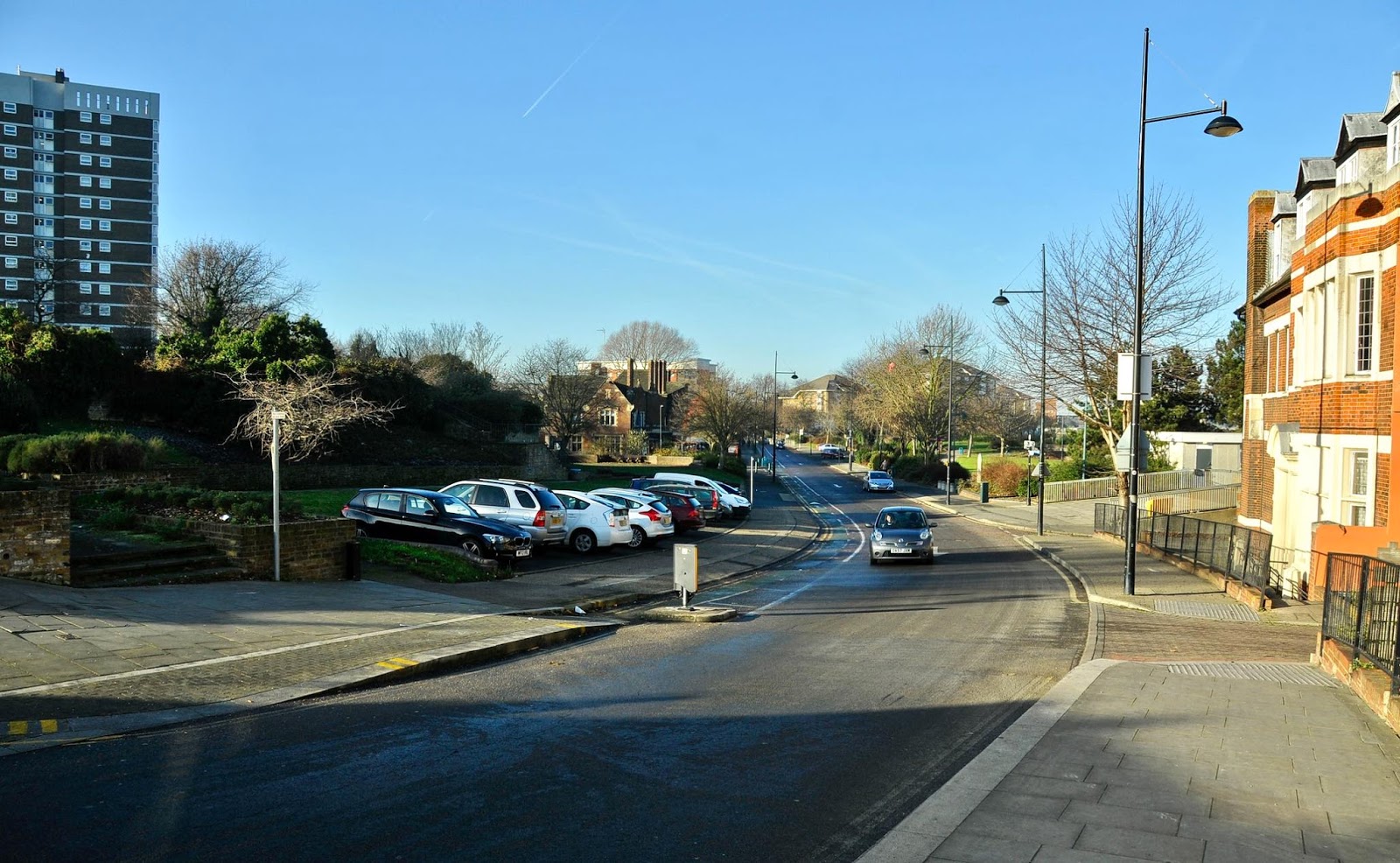
The photo above (click on it for a larger view) shows Erith High Street looking West; to the right you can see the former Police station - now (badly) converted into flats, and in the centre distance you can see The Running Horses, the only pub in Erith town centre, and sadly a shadow of its' former self. What used to be a top notch carvery and pub is pretty much a "zombie business" being kept alive by a handful of regulars. The place needs a fortune spent on it, and the only way that I can see it regaining any of its previous success is if it gets taken over by a pub company or large brewing chain. Widespread local rumours suggest that it is a toss - up between The Running Horses and the old Carnegie gifted library building in Walnut Tree Road as to which gets taken over and converted into a Wetherspoon's - if the library gets it, The Running Horses would be dead inside of six weeks in my opinion, as all trade to it would cease. Sad, for what once used to be an excellent pub that has been slowly going downhill over the last twenty years or so. 

On Wednesday afternoon, I was walking through the underpass that leads to Bexley College and Erith Station, lurking in the middle of the underpass were a group of half a dozen or so teenagers wearing hoodies and jogging bottoms; they were trying (unsuccessfully) to look intimidating whilst listening to music being played on a mobile phone. As I approached the group, I fully expected them to be listening to gangsta rap or something of that ilk. I struggled to keep a straight face when I neared them and realised that they were listening to "Mamma Mia" by Abba! They obviously were not familiar with the group (none of the teeneagers would have been born when Abba were active) and they all seemed to think that Abba were very cool. What goes around comes around. 

Notorious convicted criminal, ultra-right wing neo Nazi Joshua Bonehill has managed to get himself into the press yet again, despite being banged up in Wandsworth jail for multiple offences, the most recent of which involved the racially motivated harassment of Labour MP Luciana Berger. In addition to his original sentence of three years and four months for inciting racial hatred, he got another two years added to this for his abuse of Luciana Berger. If this was not enough, he has now sent a letter to his local newspapers – Somerset Live, the Western Gazette, in which he states that he doesn't accept the outcome of the trial and gave a catalogue of excuses while also claiming victory. In a rant, he wrote:- "With regard to the jury itself, I am told by multiple sources that several members were in fact secret service agents working for the government and the establishment I have worked to expose. And part this was a massive victory- this due to the failure of Luciana Berger to explain what actually offended her. When young Garron Helm was arrested and sent to prison for sending this woman a tweet, I promised to bring Berger to count and expose her true nature. At the end of this trial I feel that I have delivered on that promise and for that reason alone I call victory." He also gave a host of other excuses and directed more abuse towards the government and establishment including:- It was an "abortion" of justice / He was very proud of the articles he wrote / The verdict of the "Orwellian courtroom" has no impact on him / Free speech does not exist in England anymore / It was a "trial-by-Dalek" / He was subject to North Korea-style persecution / What is happening in England is "systematic rape" / White people in London are becoming extinct". He rants on for several more paragraphs, but I don’t think I will give him any more of a platform to broadcast his hateful and deluded views. I know that fellow local Bloggers, Richard of the Thamesmead Grump, and Malcolm of Bexley is Bonkers also share my opinion of Joshua Bonehill; to be honest I would not cover the deluded and hateful waste of space had he not sent me a threatening and abusive Email some time ago, which you can read in full by clicking here. The man is in entirely the right place for him – prison; I hope he stays there for a very long time to come.

Much has been written about Bexley Council and their policy of installing "Shared Space" street furniture, and paying contractors to redesign areas including Sidcup High Street and Bexleyheath Broadway to blur the distinction between the road and the pavement; the idea being that bother drivers and pedestrians will proceed more cautiously when they are unsure of what is road and what is actually pavement. The origin of term is generally linked with the work of Dutch traffic engineer Hans Monderman, who pioneered the method in the Dutch province of Friesland. Prior to the adoption of the term, street design projects carried out in ChambĂ©ry, France, by Michel Deronzier from the 1980s used the term "pedestrian priority".found that some of the claims made for shared space schemes were not justified by the evidence—particularly the claims that pedestrians are able to follow desire lines, and that shared space reduces traffic speeds. Their primary research in Ashford, Kent, suggested that in streets with high volumes of traffic, pedestrians are more likely to give way to vehicles than vice versa. Most people, but particularly women and older people, found the shared space intimidating and preferred the previous layout with conventional crossings. A study by space planning academics Hammond and Musselwhite using a case study of Widemarsh Street in Hereford found that if traffic volume was relatively low and speeds of vehicles slow anyway then vulnerable road users found it easier to share the area with vehicles, including those blind or partially sighted and older people with mobility impairments. There are wide-ranging reservations about the practicality of the shared space philosophy. In a 2006 report from the Associated Press, it was commented that traditionalists in town planning departments say the schemes rob the motorists of vital information, and reported that a spokesman for Royal National Institute of Blind People criticised the removal of familiar features such as railings, kerbs, and barriers. Shared space is bitterly opposed by many organisations representing blind, partially sighted and deaf people. Some of their members avoid shared space areas entirely. Shared surfaces, which are generally used in shared space schemes, can cause concern for the blind and partially sighted who cannot visually negotiate their way with other road users, as the lack of separation implicit in these features has also removed their safe space. The UK's Guide Dogs for the Blind Associations "Say No to Shared Streets" campaign has the support of more than thirty other disability organisations. There have been similar concerns raised by other groups representing some of the more vulnerable members of society, including Leonard Cheshire Disability, the Royal National Institute for Deaf People, and Mencap, who have noted problems when negotiating a route with motor vehicle users, leading them to challenge its fundamental premise. Lord Holmes' 2015 report Accidents by Design found that sixty-three per cent of respondents reported a negative experience of shared space, and thirty-five per cent said they actively avoided it. Lord Holmes attacked the concept as a recipe for "confusion, chaos and catastrophe". The short video below explains why blind and partially sighted people find shared spaces to be difficult and often intimidating. One of the biggest criticisms is that previously highly coloured and textured paving denoting road crossings and bus stops have been toned down to aesthetically blend in with the new look surroundings. This is contrary to the whole idea of high visibility paving for the sight impaired.


In response to the first episode of the latest Sherlock series, The Six Thatchers, Guardian TV critic Ralph Jones recently wrote an opinion piece titled "Sherlock is slowly and perversely morphing into Bond. This cannot stand". The elaborate fight scene between Sherlock Holmes and the assassin known only as Ayjay was cited as an example of Holmes’ undesirable transmogrification into an “action figure”. Now Sherlock writer/actor/co-creator Mark Gatiss has followed in Sir Arthur Conan Doyle’s footsteps by replying to a critic in verse, playfully underlining the fact that the Sherlock Holmes canon includes numerous action scenes. If you have read the original Sherlock Holmes books and short stories, you will know that Mr. Holmes was more that a little handy when it comes to fisticuffs, and he was an acknowledged expert in the martial art of Bartitsiu. Having researched this method of unarmed combat, it seems to me that many more people would benefit what some experts call the very first mixed martial art. If you have seen the two Guy Ritchie directed Sherlock Holmes movies starring Robert Downey Junior, the hand to hand fighting technique employed by Holmes to great effect was Bartitsu. The martial art was specifically designed for use by a gentleman whilst wearing a three piece suit, overcoat and hat, and whilst possibly using a walking cane or umbrella – all of which could be deployed to devastating effect when required. Bartitsu was invented in 1898, when Edward William Barton-Wright, a British engineer who had spent the previous three years living in the Empire of Japan, returned to England and announced the formation of a "New Art of Self Defence". This art, he claimed, combined the best elements of a range of fighting styles into a unified whole, which he had named Bartitsu. Barton-Wright had previously also studied "boxing, wrestling, fencing, savate and the use of the stiletto under recognised masters", reportedly testing his skills by "engaging toughs (street fighters) until (he) was satisfied in their application." He defined Bartitsu as meaning "self-defence in all its forms"; the word was a combination of his own surname and of "Jujitsu". Barton -Wright summarised the essential principles of Bartitsu as: "1) To disturb the equilibrium of your assailant. 2) To surprise him before he has time to regain his balance and use his strength. 3) If necessary, to subject the joints of any parts of his body, whether neck, shoulder, elbow, wrist, back, knee, ankle, etc. to strains that they are anatomically and mechanically unable to resist". Bartitsu was popular in the early 20th century, but fell from favour for no apparent reason, and the unfortunate Mr. Barton – Wright died a pauper in 1951 at the ripe old age of 90. Bartitsu might have been completely forgotten if not for a cryptic reference by Sir Arthur Conan - Doyle in one of his Sherlock Holmes mystery stories. In 1901 Conan Doyle had revived Holmes for a further story, The Adventure of the Empty House, in which Holmes explained his victory over Professor Moriarty in their struggle at the Reichenbach Falls by the use of "baritsu, or the Japanese system of wrestling, which has more than once been very useful to me". It may well be that Conan – Doyle changed the name slightly to avoid accusations of copyright theft; in any case confusion was spread as to the correct name, and this did not help Bartitsu from declining in proponents. Until around ten years ago, the martial art was almost completely dead. Recently however, several societies and websites dedicated to this gentleman’s system for self-defence have been established. In October 2006, the Bartitsu Society was launched, which includes information on the history, theory and practice of Barton-Wright's martial art, as well as current events relating to the Bartitsu revival. The recent Sherlock Holmes movies, and the Bartitsu moves used by Colin Firth’s character in “Kingsmen – the Secret Service” have brought the martial art back into the public awareness.


And now an article from regular Maggot Sandwich reader, and occasional contributor Dana Whiffen, who is also a local transport enthusiast. Dana writes:- "In March 2017, Victoria Coach Station will be celebrating its 85th birthday with a three-day Coach Festival from 10th to 12th March. Featuring vehicles from every decade since the grand opening on 10th March 1932, the Festival will showcase coaches, artefacts and presentations on the history of coach travel in Britain. There will be stalls from current operators, as well as a number of competitions raising money for Transport for London’s chosen charity: The Transport Benevolent Fund. The most modern coaches will also be on display and available for inspection and boarding, alongside preserved vehicles dating from the late 1920s to the 1990s. The coach station, originally conceived, constructed and operated by a consortium of coach operators coming together under the banner of London Coastal Coaches Ltd, is now owned and operated by Transport for London.  Transport for London (TfL) are keen to celebrate the history of the coach station and also to demonstrate the continuing development of the facilities within the coach station to meet the needs of the much larger and complex vehicles now using VCS and the people who travel within them. The imposing 1930s’ Art Deco building on the corner of Buckingham Palace Road and Elizabeth Street is still at the heart of the operation providing the main passenger entrance with areas containing public facilities for enquiries and booking, seated waiting areas and a range of cafes, shops and snack bars. This building and the canopy behind covering a significant part of the coach departure area are Grade 2 listed by Historic England.  The Thames Valley and Great Western Omnibus Trust (TVGWOT) are assisting TfL in organising the event by encouraging the owners of preserved coaches to bring their vehicles to this iconic and nostalgic setting to celebrate its 85th Anniversary. Whether your coach was originally operated by one of the principal express coach companies or possibly ‘on-hire’ to one of these companies at peak holiday weekends,  please download and complete an entry form available from www.tvagwot.org.uk . Forms may be submitted to (TVGWOT) by post or email to the addresses given on the form. Vehicles on display will be parked in Lanes 1-4 which are at the eastern end of the coach departure area and nearest to the main passenger entrance and facilities. The display area will be cordoned off from the operational area to allow free circulation of the public around the preserved coaches".


Local MP Teresa Pearce has been campaigning to try and keep open the Post Office at Abbey Wood, which is currently yet another to be threatened with closure.  The Abbey Wood Road branch is one of 37 Crown offices earmarked for closure or franchising across the country, with a total of 300 staff and 127 financial specialists facing redundancy. According to recent reports, 62 Post Office branches were closed and franchised last year, and the Communication Workers Union said the latest round of job cuts would bring more “misery” to workers and the customers. This seems to be just the latest in a series of sell – off and closures of public amenities, the most recent of which to be announced was the National Westminster Bank in Northumberland Heath. We are losing local resources and little seems to be done to stop the rot. There have been arguments that with services moving online, there is less need for a face to face service; to an extent with banks I can understand this – but not agree with it, but people will always need post offices, even if it is to return something unsuitable that has been bought from EBay or Amazon. I don’t think that the same arguments can be used, and I also wonder just where this will end?

The law of unintended consequences has seemingly come into force yet again; I have been talking to a couple of (anonymous) contacts I have in retail management. It would seem that the ban on giving away free plastic carrier bags at supermarkets has been successful in reducing the number of disposable bags shifted by the stores, but it has had an effect that has at the time of writing proved to be far more economically damaging. What has happened is that criminals are now able to walk around supermarkets with large reusable shopping bags on their arms, and can easily shoplift items into the anonymous bags. For shop security staff, someone carrying a large shopping bag around the store used to be a significant indicator that they could well be a shoplifter, and the security staff would consequently pay them more attention. Now that virtually all shoppers carry their own bags round the store, the criminals can far more easily blend in with the innocent shoppers. I have been told that the increased levels of stock loss have completely wiped out the lowered costs of supplying single use shopping bags in many high - street stores, but the management do not want to highlight the issue for fear of being thought of as "anti environment".  On top of this, the loss levels of wire shopping baskets has markedly increased; major supermarkets have already ordered thousands of extra wire baskets, as more of them go missing as shoppers turn to theft rather than pay for plastic bags, and the figures would seem to back this up - but once again the industry is incredibly reticent about discussing the phenomenon, as they fear it will affect corporate images. Over the course of a year, one major store in Wales had almost five hundred wire shopping baskets stolen when it began charging 5p for plastic bags - resulting in a four-figure loss from just one site. Although research predicts it will cost shoppers just £6.50 a year, history shows that some shoppers will resort to theft to get around the new law. What retailers do not want to be seen doing is restricting the use of wire baskets in the way most already do with the more valuable shopping trolleys. Whilst many have debated fitting security tags to shopping baskets in the way trolleys have had for the best part of twenty years, the cost / benefit balance is far less compelling, and they are worried about discouraging shoppers in what is already a cut - throat market place. What do you think? Drop me a comment below, or Email me at hugh.neal@gmail.com.

Every town has what some would call "local colour" - one or more individuals who regularly appear in and around the town and make themselves noticeable for one or more reasons. Erith has had such a person for many years, and scruffy and unkempt chap of indeterminate age who normally can be seen sitting either on one of the benches outside the Post Office in Bexley Road, or alternatively on a bench outside of the Aglory African cash and carry store in Erith High Street. In either location he can usually be seen swigging from a can of Special Brew or White Cider, and later in the day he sometimes shouts at the pigeons, the passing traffic, or indeed something he has seen which nobody else can. Sadly this vulnerable individual has been reported missing, and at the time of writing he has not been seen since Tuesday last week. The person's name is Mark White, and according to a report in the News Shopper, he was last seen in Park Crescent last Tuesday afternoon. Although he looks to be in his mid to late 70's, he is in fact only 54 years old. As can be surmised, Mark White has serious mental health issues, as well as problems with his general health, and is known to sleep rough in various locations in Erith. You can read the original report, complete with a photo of him here. Concerns grow for his welfare; the current icy weather is most definitely not conducive to the outside life, and combined with his alcohol dependency problems, there are concerns that he may have passed out somewhere and then suffered from hypothermia. I have seen him asleep on a bench in the gardens at the junction of Saltford Road and Erith High Street on many occasions. Such a location, on the banks of the River Thames is bitterly cold, with the icy wind coming straight off the river. Police have asked that if anyone knows the location of Mark White, they should contact them immediately. *UPDATE* - Just as the Maggot Sandwich was going to press, an announcement has been released that Mark White has been found safe and well, despite the poor weather conditions. Hopefully he will now get some care and will be taken off the streets; maybe this scare will mean he gets the treatment and attention that he has been missing for so long - it is just possible that this is a positive outcome, after all.


The photo above shows the long established Belvedere Tandoori Indian restaurant in Nuxley Road, Upper Belvedere (there is no such place as Nuxley Village - it is a fictional invention of estate agents who don't live in the area). As you can see in the photograph, in addition to the menu there are several other notices in the windows. These are effectively the restaurant's suicide note. They announce that the restaurant no longer serves alcohol (and from reports I have heard, also does not allow "bring your own" either). In a predominantly non Muslim area this is a sure fire way to kill off a restaurant - most especially when there is a larger and more attractive rival less than two hundred metres away in the form of the rather good, very large (and serving alcohol) Spice Master restaurant, just ready to hoover up customers. I have heard rumours that the owner is trying to sell the place, but surrendering the drinks licence makes the place a lot less attractive to a potential buyer. If you know any more, please let me know. Leave a comment below, or Email me at hugh.neal@gmail.com.

The local area seems to be targeted by a number of companies offering credit cards to people on low incomes and with poor credit histories. I have had a series of envelopes posted through my front door, which I generally remove any personal details, then take round to be recycled. This time I decided to read through the documentation just to see what was on offer. Personally I don’t own a credit card, as I have little or no need for one. If I cannot afford something immediately, I save up until I can. I am not a believer in personal debt – I have my (miniscule) mortgage, but that is it. When I read the small print of the credit card application leaflet from a company called Vanquis Bank, I was appalled. You may recall that not long ago I wrote that being on a low income is very expensive. Lenders charge far higher interest rates to people they feel are a bad credit risk; conversely this means that the borrower is actually more likely to default due to the crippling interest charges. The Vanquis Bank credit card has a base interest rate of 39.9 to 59.9 percent, depending on the financial situation of the applicant. The card offers a very low initial credit limit, from £150 to £1,000, though the bank does state that if card repayments meet certain criteria, the credit limit can be raised every four months to a maximum level of £4,000. Compared to this, Barclaycard, MBNA, Sainsbury Nectar and Leeds Building Society all offer a credit card that charges a fixed 18.9 percent interest rate and far superior terms and conditions. Vanquis Bank is an operating arm of the Provident Financial Group, a financial services company with an income in excess of £1 billion a year, and Vanquis is designed to siphon as much of that cash from low income earners as possible. It may be legal, but in my view it is not moral. Once again the poor get financially hammered for being poor. I feel fortunate that I have a healthy income and don’t need to worry as the end of the month approaches, but I am acutely aware that many people are not nearly so fortunate.

I would imagine that you, like me were unaware that a large multinational company with a Royal Warrant from the Queen was based locally.  Quite by accident I came across details of Versapak, who describe themselves thus:- "The Versapak Group is a UK based company with subsidiaries in Europe and a distribution network worldwide. Specialising in the manufacture of tamper evident security containers, the Group operates through six main brands:  Versapak International - tamper evident reusable pouches and bags, ballot boxes, medical bags, cash security bags and document and mail carriers, which are secured using a unique security seal locking mechanism.  All International Customers should visit www.versapakinternational.com. Versapak Europe GmbH - Supplies all Versapak products in Germany. Versapak Romania - Our main manufacturing base, wholly owned by The Versapak Group. Supplies all Versapak products in Romania. Versapak Doping Control - Tamper evident security containers for the secure transport of urine and blood samples for anti-doping within sport. Versapak Manufacturing - We can make any bag, for any purpose, to meet a customers' exact requirements. Bond Mailroom - tamper evident reusable pouches and bags featuring the unique T-shaped security seal, and mailroom equipment such as mail trolleys, mail sorting units and sack holders".  Versapak have their international headquarters in 4 Veridion Way, Erith - which is actually in Abbey Wood, just off Yarnton Way, in one of those quirks of location naming I have moaned about in the past. You can see a short explanatory video regarding the company below.

Sunday, June 19, 2016

Wetherspoons in Erith.


I had some very welcome news earlier this week. I have been in correspondence with several hospitality companies recently, to try and find out if any of them had plans to open a pub or restaurant in Erith. The town is woefully lacking in anywhere to go for a drink, or get something  to eat in the evening. The only places in central Erith serving food to be eaten with a knife and fork whilst sitting at a table are Mambocino – which closes at 6pm when the Erith Riverside Shopping Centre closes its security gates, and the cafĂ© in Morrison’s supermarket. The Running Horses pub on Erith High Street does still sporadically have a food offering, but according to several reports I have received it is so awful that I have not included it here - I have also heard that what food there is tends to only be offered when the staff can be bothered, which is not daily. It seems that the riverside pub, which back in the 80’s and early 90’s was so popular that you would often have to book the upstairs carvery in advance, especially on Sundays when it was always packed, is nowadays in what seems like a terminal decline. The place has been bravely slogging on with a hard-core of regular drinkers for a long while, but the food side of the business is nothing whatsoever like it used to be. The Running Horses is in a superb location and is a lovely 1930’s era reproduction Tudor style building. To be honest it could be restored back to its heyday if a substantial financial investment was made in the place, which I don’t think the current landlord / manager is in a position to do. I have long suspected that the land The Running Horses is sitting on is now worth substantially more than the pub itself, and that it is quite possible that the building is currently being “land banked” waiting for a suitable developer to come along and build yet more flats. Land in Erith is about to skyrocket in value, and it seems to me that it is not a question of if, but when this will happen. I would love to see The Runnning Horses become the massive success that it used to be, but honestly, unless something dramatic happens, I don't see a bright future for it in the current guise. Anyway, on Monday morning I received an Email from JD Wetherspoon which said (and I quote):- "We are currently considering Erith as a possible location for a JD Wetherspoon pub, and we are in the process of obtaining feedback from our Operations Teams on their views on the viability of acquiring a site in the town". I don't know what locations they are looking at, but the three options that seem most likely to me are:- 1) The three empty retail units opposite Erith Health Centre, but this would likely elicit objections from the residents in the apartments above, and the units are also quite close to the Sherwood House residential care and sheltered housing home. The proximity of the home was the primary reason why Wetherspoon’s were unable to convert the old Erith Odeon Cinema into a pub back in 1998. The levels of noise and disturbance which customers would make in the evenings was judged as being too high in what is classed as a residential area. On top of this, I understand that a commercial gymnasium has designs on the site. 2) The old Carnegie Library building in Walnut Tree Road, which has been abandoned and unused for nearly six years - a photo of it is above - click on it for a larger version.  The old library building was going to be converted into a training centre for the hospitality and hotel industry as part of Bexley College, but the funding fell through, and the project was cancelled. Now that Bexley College is being administered by Bromley College, the future of other potential collaborative projects is unclear. Wetherspoon’s have a very good reputation for sensitive restoration of old buildings; my understanding is that the former Carnegie Library has a severe damp problem on the main brick frontage, and the lack of preventative maintenance has caused a number of fairly serious issues with the building fabric. Wetherspoon’s have deep enough pockets to be able to finance major construction, conversion and conservation work if they did decide to purchase the building for use as a pub / restaurant. The only downside I can think of is that the former library has no local parking, though local public transport links are excellent. This does not usually deter Wetherspoon’s, who seem more interested in the local customer demographic, than parking issues. 3) The aforementioned Running Horses – which also has good public transport links, on site car parking, and an excellent location – the downside is that the interior would need extensive modification to make it more open plan. Currently the pub has a downstairs public bar, and a smaller saloon bar which is seldom opened. Upstairs there is a large open plan area which has been used both as a restaurant / carvery and for wedding receptions and the like. The Running Horses ticks most of the boxes that I imagine that Wetherspoon’s would be looking at, with the exception of the internal layout. It would be difficult but possible to convert the two downstairs bars into a single open – plan layout as favoured by the pub company. Of the three locations considered thus far, my own opinion is that the Carnegie Library and The Running Horses are the two most likely to be considered by Wetherspoon’s.  I don't think that the former White Hart / Potion bar would be an option – the ground floor bar area is too small, and will have residential property on top and behind it, when the plans to redevelop  the upstairs of the pub, and the extensive gardens get a block of low rise flats built on them, as I have previously featured. I also think the three units opposite the Health Centre don’t stand a chance due to the proximity to residential accommodation. What do you think? Personally I feel that Erith is crying out for somewhere to go for a drink or informal “sit down” meal. If it gets the go – ahead, it will provide some much needed local jobs, and enable local people to actually socialise in Erith, rather than having to travel to Lower Belvedere (The Morgan), Bexleyheath (lots of places) or Dartford (ditto) in order to get a drink and a reasonably priced meal. I think a Wetherspoon’s pub opening in central Erith would be a very positive event, and the sooner it happens the better. If you disagree, or have a particular point to make, you can either leave a comment below, or Email me at hugh.neal@gmail.com


Regular readers will know that I have been banging on about IT security issues for a very long time. I am especially concerned by contactless debit cards, as they are notoriously insecure. The situation now seems to have got worse, as a criminal group have commercialised the card cracking process, and it can now be bought online. A criminal group going under the name of The CC Buddies is selling a high tech device on the Dark Web that is capable of copying details from contactless debit cards if held as close as eight centimetres away from a victim's card. CC Buddies claim that their device, named Contactless Infusion X5, can copy up to 15 bank cards per second, something that may come in handy if a crook is going through a crowd at a concert or is in a crowded tube carriage.  X5 is designed to copy data from the radio chip embedded in modern RFID contactless bank cards. This data is stored on X5's internal storage system, and thieves can connect the device to their PC using USB cables and transfer it using special software, also supplied by CC Buddies. The device can collect data such as the card's number and expiration date. If the debit cards RFID chip stores information such as the card holder’s name, home address, and a mini statement, X5 can steal that data as well. When it copies credit card numbers, X5 encrypts the data. The software provided by CC Buddies will allow the crooks to decrypt and download the stolen information from their X5 device to a Windows (XP or higher) PC, and start creating fake debit cards using blank plastic cards. Crooks can get their hands on an X5 device for only 1.2 Bitcoin (around £600). CC Buddies says they ship devices via mail, and each buyer will receive the X5 device, a USB cable for charging and data transfers, and 20 blank cards. Below are X5's technical specifications, as provided by CC Buddies in their Dark Web advert, at the time of writing. “The Contactless Infusion X5 is the first contactless bank card hacker sold in the black market. This product has been designed and developed by The CC Buddies. The Contactless Infusion X5 is capable to detect and read ANY bank card from just 8 centimetres away! And reading at an amazing 1024kbps this powerful contactless reader will read and save at approximately 15 bank cards per second! The Contactless Infusion X5 has a built-in 5V battery charged via a USB 3.0 cable (provided). Takes approximately  3 hours to fully charge and it will last up to 10 hours in constant use. It’s also capable to read many other cards! Any card that is running on a 13.56mhz frequency, the Contactless Infusion X5 is able to read, and capture the data! But because the software we provide has been developed specifically to decrypt bank cards it won’t be able to decrypt any other cards, but we’re working on it and soon it will!!  ” This is all very worrying stuff. Personally I avoid all contactless cards - they are more trouble than they are worth in my opinion.

You may recall that there was great controversy when Bexley Council announced that they were ending the Danson Festival. Back in May 2014, I wrote: "It would appear from what I can gather that Bexley Council have effectively pulled the plug on the Danson Festival permanently. It has been known for some time that the festival was being called off this year, due, so the council said to drainage problems made worse by the terribly wet conditions last Autumn and Winter. It was originally intimated that the festival would be back as normal next year. Now Councillor Don Massey has announced that substantial engineering work is required to fix the problems, and that the council currently does not have the money to carry out the work. Bearing in mind over 60,000 people visited the festival last year, to drop it completely is quite a brave move, especially in the light of the forthcoming council elections. My understanding was that the festival was pretty much self funding, and usually turned a modest profit. It showcased local clubs and not for profit groups, and gave a lot of good causes the opportunity to both raise awareness and also fund raise. Several readers have left comments on the News Shopper website stating that the real reason for the cancellation of the Danson Festival is that the wealthy people who live in the big houses around Danson Park do not want the noise and disruption that the festival brings. Compared with other boroughs in the area, Bexley does very little if anything in terms of public festivities or events; it seems to be very keen to be able to continue to boast that they have kept council tax rates the same as last year, which seems to involve making more cuts upon cuts. The same cannot be said of the wage bill of the council leaders, which, as Malcolm Knight of “Bexley is Bonkers” has repeatedly pointed out, are amongst the highest in Greater London". The myth about the poor drainage in the park has been exposed now - a commercial company called Oakleigh Fairs is running an event called the "Danson Park Country Fair" on Saturday the 2nd and Sunday the 3rd of July in Danson Park, Welling. Unlike the previous fair, it is not free, and an entrance fee will be levied against visitors. Bearing in mind that Bexley Council stated that the reason for the cancellation of the original fair was that the cost of improving ground drainage to make the grassed areas suitable to use after heavy rain was too great for them, and that they were regretfully having to end the very popular free event turns out not surprisingly to be completely untrue. No drainage improvements of any description have been made, and yet after what is turning into the wettest summer in living memory, a mass event in Danson Park is able to go ahead with absolutely no reference to the reason the council used to cancel the original, free event. Of course, the commercial company called Oakleigh Fairs are able to go ahead with their for profit event; no doubt they are paying a fat fee to Bexley Council for the right to hold the two day fair. I could not make this up. Please feel free to leave a comment below, or Email me at hugh.neal@gmail.com.


The News Shopper have been running a story on how “shoddy” the grounds maintenance work has been in a number of public open spaces in the London Borough of Bexley. The poor level of workmanship in relatively simple tasks such as mowing a lawn is evident from the photographs sent to the local newspaper. I understand that some local residents have taken to mowing the grassed areas themselves, as they are so frustrated by the poor service the council contractors have been providing. I have spoken to a couple of residents of Manor Road, Erith who share this frustration. As you may know, Manor Road is a very long carriageway that has mixed use. The Western end is exclusively residential, whilst the Eastern end is almost exclusively industrial. Many heavy vehicles and plant travel along the road during the day, and consequently a lot of dust in the summer, and mud in the winter is generated. Historically the road and pavements were regularly swept to keep the level of pollution down, but in the last few months the sweeping has ceased and both the road and the pathways are in a right old state. You can see an example in the photo above, which shows one of the pedestrian crossing points near the Frobisher Road Estate. The photo was taken just after the torrential rainfall and minor flash flood on Friday afternoon, and much of the dust and silt that normally lines the kerb had temporarily washed away, but it will be back very soon. It would seem that the rapacious Bexley Council have cut back on street sweeping on top of everything else they are notorious for cutting. Do you have any similar experiences? Leave a comment below, or Email me at hugh.neal@gmail.com.


You may recall that back in August of last year I featured an expose of a fraud called the “Funky Clock”. This scam may have now disappeared, but another called Zuuvu seems to have taken its place. A number of readers had rightly become suspicious of a website which claimed that one could legally purchase a brand new iPhone 6 for the price of £1. The website advertising this had links from the tabloid newspaper website The Daily Star, and several other reputable (!) locations. When one followed the link, you were presented with what appeared at first glance to be a page from the BBC News website. It included a story about how people in the UK could get a brand new iPhone 6 for £1. Upon reading the story, alarm bells started to ring; the writing style was nothing like BBC News standard, and there was a problem with the links on the page – they all led to the same website – this is a common trick carried out by scammers – create a fake “honey trap” site to redirect web traffic to another website. The so called "BBC" site was nothing but a fake. The second site was called “Funky Clock” which ran “special offers” amongst “skill and speed” competitions, where participants purchased credits to use to play games, the winner of which supposedly won an iPhone 6. When you signed up for the “free” service, you were prompted to enter your bank details “for verification purposes”. What was only displayed in microscopic text is that the “free” period only lasted for three days, and that after that Funky Clock debited your bank account by £74 a month, from then until the end of time. They also took large amounts of unauthorised cash, sometimes into the thousands of pounds from subscribers accounts. No cheap iPhones, no deals – the whole thing was a massive scam. It would appear that many Internet Service Providers, notably including Virgin were duped into forwarding “Genuine offer” messages from Funky Clock to their subscribers, thus giving a veneer of apparent respectability to the confidence trick. This is a classic case of “if it seems too good to be true, it generally is”. After a massive amount of negative publicity, the scammers closed that particular operation, but did not close down altogether. They are now back with a new look, but the same nefarious purpose – to rob innocent people of their hard earned cash. You can see a screen capture of their redesigned website above - click on the image for a larger version.  Be warned – treat anything that says they are giving away high value items for next to nothing as a con until it can be verifiably proved otherwise (a very fat chance indeed). Unfortunately the criminals will continue such scams for as long as there are vulnerable people to fall prey to them. The Zuuvu scammers do make an elementary error on their deceptive website - they talk about the UK, but they mention prices in Euros - anyone with half a brain cell will know that the UK uses the Pound Sterling, not the Euro. Basic error and in its way, a giveaway to the whole fraud.  You have been warned.

Now that British Astronaut Tim Peake is safely back on Earth, I thought I would feature one of the educational projects he was working on whilst in orbit. He was very involved with encouraging school children to develop an interest in science and technology. This was promoted by a series of live video links from the International Space Station, and by pre - scheduled audio contacts via amateur radio.  The ten school contacts with Tim Peake on the ISS during his Principia mission have inspired thousands of young people and introduced them to amateur radio in a new and exciting way. The new video below celebrates these historic events and the range of linked activities the schools have enjoyed. Beginning with the exhilaration of the launch, it follows the competition for schools to host the ARISS contacts, and showcases the variety of science, technology, engineering, maths (STEM) and arts activities that helped pupils to understand more about space and amateur radio. The contacts themselves, often led by newly-licensed pupils, were the successful culmination of many months of work and anticipation. Leave a comment below, or Email me at hugh.neal@gmail.com.

Sunday, June 12, 2016

Out of Wind.


The Erith Wind Turbine has rapidly become one of the major landmarks of the town, even though it is actually located far closer to Slade Green, than to central Erith. The Wind Turbine is situated on the banks of the River Thames on the Manford Industrial Estate, which is also home to the excellent, multi award - winning Bexley Brewery. The location of the wind turbine was somewhat controversial when it was first installed back in October 2012, with some Slade Green residents objecting to it. Since then it has formed an integral part of the local landscape. It was fairly widely anticipated that further wind turbines would be constructed locally, as the Government sought to create as much energy using renewable energy sources as possible. A recent report may well have put paid to this, however. It would seem that the UK has the wrong type of wind. The head of the wind industry’s trade body in the UK has admitted England isn’t windy enough for any more wind farms. “We are almost certainly not talking about the possibility of new plants in England. The project economics wouldn’t work; the wind speeds don’t allow for it,” essentially the wind in the UK is too sporadic and unreliable to make for an efficient renewable energy source. Hugh McNeal (no relation - I promise!) head of Renewable UK told the Daily Telegraph. McNeal joined the lobby group from the civil service, where he was “Director of Change” (a real job title) at the Department of Energy and Climate Change during its most wind-friendly phase. Government subsidies for new onshore wind turbines were quietly dropped on the 1st April this year; In his final interview before his untimely death from cancer, DECC’s chief scientific advisor Sir David Mackay called it an “appalling delusion” that the UK could meet its energy needs from renewables. Wind turbines were simply a "waste of money" in winter, for "when the wind blows you are going to have to either turn those wind turbines down or something else down that you have already paid for, like the nuclear or coal fired generators". Solar generation only works in really sunny countries. The international renewables agency IRENA recently admitted that renewable usage is actually falling in China, India and Mexico. The EU quietly dropped its mandate that 10 per cent of transport be powered by renewables 2020 earlier this year. Bill Gates has called for the huge renewables subsidies wasted on wind and solar to be diverted to more potentially useful low carbon innovation. I think that the Erith wind turbine probably pays its' way, as the wind off the River Thames is a lot more reliable than that in other areas, but that is the exception, rather than the rule. It is a pity that the so - called renewable energy from wind and the sun is not actually reliable enough to make a significant contribution to the UK energy reserve, but I suppose that we have to be realistic, rather than idealistic.

As I have previously written, I have concerns over the quality of local journalism, now that the staff of the News Shopper have moved out of their long - term home in Petts Wood and are now either working from home, or from their new base in West London, far from the area they are tasked with covering. A prime example of this happened this week. A reporter named James Parsons wrote a piece about a woman who is resident at the former Homeleigh Care Home in Avenue Road, Erith, which has been converted into a temporary respite shelter for homeless people. The problem with the piece was (and at the time of writing, currently is) that the reporter refers to the former care home being located in Sidcup rather than Erith. I Emailed James Parsons to point out his error, and got an out of office auto reply, and since then several readers have left comments on the article pointing out the error in the story, but thus far it has not been corrected; the story was originally posted on Wednesday, and it is now Sunday. Very poor journalism. What do you think? Leave a comment below, or Email me at hugh.neal@gmail.com.

Long - term Maggot Sandwich readers will be aware of my strong antipathy towards gambling, and especially towards Fixed Odds Betting Terminals used in bookmakers shops. There is now a clinic in Fulham which specialises in supporting and helping people with gambling problems to overcome their addiction: The National Problem Gambling Clinic - around fifteen problem gamblers are referred to the clinic every week from across the country; every year between 750 and 900 people start treatment here. Most are male, and in their 30s and 40s; about 70 percent are working. “Yet, by the time we see them, they have lost jobs or lost opportunities professionally because of their gambling and they have often compromised important relationships,” Bowden-Jones says. “They are usually highly stressed and there is a lot of guilt, when they look at the negative consequences on their employers, spouse, children, employers.” Most patients are spending their money on the high street roulette machines – known as fixed odds betting terminals (often described as the crack cocaine of gambling, because of the speed with which large sums can be staked, and lost), and on sports betting, usually done online at home. The easy availability of online, in-game betting has made sports betting increasingly popular over the past decade. While fifteen years ago people might only have been able to bet on the result of a game, at the bookmakers, now they can bet online, on a variety of scenarios within the game, making watching the sport highly stressful for gamblers. Bowden-Jones, who previously specialised in alcohol and drug addiction, founded the NHS’s first and only specialist gambling clinic, funded by the Central and North West London NHS Foundation Trust, in 2008. It had become obvious, amid rising concern about the growing presence of super-casinos and new easy access to betting shops, that there was a desperate need for it. She has been innovative and experimental, trialling the use of a cravings-suppressing drug, naltrexone, more commonly prescribed to alcoholics and heroin addicts. It is a last-resort treatment for gamblers whose addiction has persisted despite the clinic’s interventions. Personally I would have thought drastic cutbacks and legal restrictions on betting shops and online gambling, and especially on Fixed Odds Betting Terminals would be the best way forward. What do you think?


One of my anonymous sources has alerted me to the news that a licence application has been made to Bexley Council for a new Micro Pub to be called the Hackney Carriage, which (if permission is granted, and I have little doubt that it will), would be located at 165 Station Road, Sidcup. This is good news; Bexley is becoming a leader in encouraging and supporting Micro Pubs. I would like to see one in Erith or Northumberland Heath - there are plenty of suitable unused shop units available, and the demand is certainly there. Central Erith only has one pub - The Running Horses (see the photo above - click on it for a larger view), which is sadly a bare shadow of what it used to be. I would love to see it as a lively and busy family friendly place with an excellent upstairs restaurant, but instead it limps along with a small band of loyal regulars. A large investment really needs to be made in the place - perhaps if a large pub company or brewer such as Shepherd Neame or Fuller's were to buy it, they would be able to turn the place around once and for all. I fear that when things get particularly tight for the current owners, they may be tempted to sell of the building and plot of land on which it sits to a property developer to demolish the pub and replace it with yet more riverside apartments, and I know I am far from being alone in this concern. The Running Horses is an excellent building, and with some love and cash it could bring it back to its' glory days in the late 1980's when you needed to book a week in advance to get a table in the upstairs carvery on a Sunday lunchtime. Another beer related story was brought to my attention earlier in the week, and it has parallels with an experience of my own. A Belgian brewery has developed an impressive engineering solution to a problem they had with transporting their beers. Bruges brewery De Halve Maan (The Half Moon) is about to open the valves on a €4m beer pipeline designed to carry vital supplies the 3.2km from its city centre production facility to its bottling plant. The subterranean ale conduit was the brainchild of De Halve Maan's head brewer Xavier Vanneste, who wanted a solution to the problem of beer tanker lorries negotiating the city's narrow streets around the brewery in Walplein square. According to an article in the Wall Street Journal, Vanneste was inspired by workers "laying underground utility cables in front of his house". He admitted: "It all started as a joke. Nobody believed it was going to work." Four years later, though, and the epic project is just weeks away from completion. Vanneste raised an impressive €300,000 of the pipeline budget with a crowdfunding initiative, which offered investors with €7,500 to spare "one 33cl bottle of Brugse Zot Blond every day for the rest of your life". Less wealthy customers were tempted with one case of 24 bottles of Brugse Zot Blond a year for life (€800), or "one presentation bottle of 75cl of Brugse Zot Blond a year for life" for a modest €220. Restaurateur Philippe Le Loup was one of those who stumped up €7,500, and he reckons that at a bottle a day he'll have recouped his investment in 15 years. Le Loup's restaurant is a few hundred metres from the pipeline, and he said he'd have welcomed a direct connection, to save him "a lot of keg-dragging". Sadly for him, and indeed those Belgian citizens who are no doubt already planning just how to tap the polyethylene pipe, Vanneste said this would prove "impossible", rating the tube as "stronger than steel". The Belgian pipe development is the longest and by far the most ambitious beer pipeline in the world, but it is far from the only one. Shepherd Neame down at their historic brewery in Faversham have what they call "The Beer Bridge" - their main brewery is on one side of a busy road, and their bottling plant is on the other. The have constructed an overhead gantry which contains beer piped from the brewery to the bottling plant. Apparently there have been several attempts to drill into the pipes and siphon off the beer, though to date none appear to have been successful. The Belgian enterprise is far more ambitious - you can see a short video on the brewery behind it below. Please feel free to leave a comment below, or Email me at hugh.neal@gmail.com.


The whole of the South East of England is under intense population pressure for a multitude of reasons I’m not about to explore here. Others with higher levels of insight have already done so far more eloquently than I. Nevertheless the population boom and lack of investment in new housing stock have caused property prices to boom, and the rental market to explode. Those with lots of money (many of whom are absentee foreign investors seeking to get their cash into the UK economy, which they judge to be a stable and reliable place to invest) have been doing very nicely indeed out of the situation, whilst the rest of us struggle. This week the News Shopper has highlighted a particular problem with the London Borough of Bexley. Unusually for a local council, Bexley does not have a Tenancy Relations Officer to supervise the private landlord market in the Borough. This has partly led to the current situation where some unscrupulous private landlords are dividing up houses into tiny flats, often contrary to the building and health and safety regulations. The News shopper has recently reported that a petition has been started which is designed to persuade Bexley Council to introduce legislation to force developers to apply for planning permission before converting two-bed family homes into six separate bedsits, known as an Article 4 direction. Bexley would appear to have a particular problem with what is known as Houses of Multiple Occupancy (HMO). Many of these HMO houses are used as hostels for vulnerable people with drug and / or mental health problems, or ex – offenders, and many home owners feel intimidated by the HMO residents. Because Bexley Council have historically not engaged with HMO landlords, they lack any data on how many, and in what areas HMO houses are located. The petition that has been set up on the Change.org website can be seen here. Reading the comments from the local residents that have signed the petition, it would seem that feeling is running very high indeed on the matter. One fairly typical comment is from a lady called Donna Everist who writes:- “I think it's wrong that law abiding, hardworking people, who pay a mortgage, taxes, council taxes etc could have the house next door turned into bedsits filled with people who have done none of these, and probably never will. If the comments about the sort of people who will reside in these bedsits is true, then I'm lost for words!” Other comments are somewhat less measured, with often recurring references to “paedos, druggies, nutters and scum”. It will be instructive to see what happens when the petition is handed to Teresa Pearce MP and David Evennett MP – our two local politicians. I get the feeling this story will run for a long time to come.

The HMO story highlights the somewhat contradictory situation with property in The London Borough of Bexley; not only is the creation of multi occupancy residences unmonitored and apparently unregulated, but on top of this, towns in the borough also top the polls regarding both property affordability and speed of selling. A recent report by estate agent Rightmove stated that homes in Bexleyheath  — where average prices stand at £375,259 — sell in just three weeks, thanks a potent local mix of affordable property, grammar schools, and a 35-minute commute to central London. Abbey Wood is a close second, benefiting from the imminent arrival of the Elizabeth line (formerly Crossrail). Property there sells in an average of 22 days, and an average house costs £326,815. Dartford’s market is equally active, with homes that also take 22 days to sell, at an average price of £290,523. The most expensive town in the London Borough of Bexley, with an average price of £471,931, is Bexley village, while the cheapest is Erith, with an average price of £261,433. They are also the areas of London where prices are predicted to start rising fastest. My own property, Pewty Acres has risen in value so much that I would be unable to purchase it nowadays. A report released by property experts CBRE Residential back in January backed this finding up; it compared the average wage and average house price for each London borough, giving first-time buyers a good idea of how far their annual income will stretch. “While affordability for many first-time buyers in London may be stretched, there are still a number of locations that are continuing to attract these buyers with lower values and potential for growth," says Jennet Siebrits, head of residential research at CBRE. "By measuring the average earnings coupled with local house prices, we anticipate that Bexley is set to further appeal to those looking for increased value for money." The report was featured in the London Evening Standard at the time, though through lazy journalism and lack of proper research, the paper described Bexley as being in “East London” – something guaranteed to raise the hackles of many local people. Bexleyheath was the featured town in the weekly Homes and Property section of the London Evening Standard last Wednesday afternoon - click here to see their coverage.


I have been in communication with the team behind Erith Fun Day, which for the first time will be held in Erith Sports Centre, instead of the tradition venue in Erith Riverside Gardens, overlooking the River Thames. Several readers have been displeased regarding the change of venue, which some feel is less accessible. The Fun Day management team responded with this very open and honest reply:- “Firstly, I should say that this was a big decision for us which we really did discuss at length as we are so aware of making use of the gardens. Nobody wants developers to get their hands on this land and so our plan is to hopefully put on another event later this year.  At Rotary we have discussed a couple of ideas including a beer festival and an open air  movie night. Anyway, onto our reasons for making the move. The first thing is probably to make you aware of our funding issues. We are all volunteers and do not receive any funding apart from what we raise. The Erith Group are fabulous and give us £500 each year which is our starting point.  This just covers the cost of gardens/park hire and our licences. On top of this we have to provide toilet facilities, generator hire ,publicity and printing costs, first aid cover  and a myriad of smaller things. Dan our Dj and MC gives his time and equipment for free and counts towards our sponsors. The mobile bar company gives us a small percentage of takings as does Forrest Fairs.  The last two are paid after the event and we do not know how much we will get but this  then goes into the kitty for next year.! Based on the feedback we received from last year, the biggest issue was that there was not enough to do and the queues for children's activities were too long.  This was exasperated by the fact that in order to raise funds we needed more volunteers to operate things like the bouncy castle.  So we had to decide how we could put on more activities etc.  This of course meant raising more money from stallholders etc. We could not add more to the Riverside gardens as there were too many safety issues getting vehicles on and off site and also access is severely restricted.  We have raised this issue with the council but it is unlikely the bollards will be re-positioned. The only way we could find was to move to a larger venue, ie the Rec. This has enabled Forrest Fairs to provide a couple more children's rides and for us to offer a lot more stalls for sale allowing us to raise more funds. We try to keep our stall charges at the lowest possible level to encourage small business to join in. We currently charge £12 for charities and £20 for individuals who also get the use of Rotary club insurance cover for the day.   We reinvest every penny we receive and strive to make the day all about Erith and our community.  We really are hoping that the venue change will work but are as unsure as yourself. There are better parking facilities and it really is just across the road from Morrison’s, KFC, McDonalds etc. We are producing more banners this year to really get the word out and will handing out and door dropping leaflets. We are all fingers crossed for good weather and a healthy attendance!!"

I was also contacted midweek by a reader who wishes local people to be made aware that a valuable local resource is about to be closed down with little consultation and very little advanced publicity – until now. A campaign has been started to stop a local recording and practice studio being closed down. Here is the situation in their own words:- “For over 20 years Abbey Music Studios (AMS) in Abbey Wood (London SE2) has provided a music hub for local artists and bands for rehearsal and recording purposes, and for musicians and interested visitors from all over the world. It has also provided free recording and group sessions to local NHS patients and other individuals with mental health and learning difficulties. The Studio building is within the grounds of Goldie Leigh Hospital and now the Oxleas NHS Trust who run the Hospital have given the Studio notice that its lease will not be renewed and that it must close by 6 July. The Trust say they want to use the building for other purposes. This is despite there being several other large, un-used buildings within the Hospital grounds, some which have stood empty for over 20 years. The closure will be a devastating blow to the livelihood of those who work at the Studio, and will remove the vital role the Studio plays in providing services to mental health patients and to the local community. The Studio building was completely derelict, vandalised, flooded and unusable when AMS took it over in 1994. The gaping holes in the roof of the building were repaired at the expense of AMS who have invested thousands of pounds in renovating the building and fitting it out with state of the art, made-to-measure, recording equipment, and rehearsal rooms. The NHS Trust paid no funds whatsoever towards the renovation of the building, but they now want to take it back in its pristine condition, with no offers of compensation or alternative accommodation. The Trust seem to be happy to put an end to local mental health patients’ music sessions, despite the fact that for some of these patients it is the only time they have away from their Units. The Studio has provided these 2 hour music sessions two or three times a week for over 20 years and continues to do so. Patients are able to play/learn musical instruments, record their work, rehabilitate and socialise in a safe and friendly environment. This also helps them from becoming institutionalised. The patients’ local Carers have always been delighted with the service the Studio provides. They understand the benefits that music can bring to those with mental health issues, but that understanding does not seem to be shared by the Trust’s managers. This is a service which should be embraced and developed, not discontinued. Of course, the Studio also provides a very beneficial service to bands, singers, DJs etc, in the local community and beyond. Thousands of musicians have cut their teeth at AMS over the last 20 years, and developed their craft to a professional level. Recent users of the Studio include Jaz Ellington, a successful contestant on The Voice UK TV show, and members of bands such as Squeeze and Nine Below Zero. AMS does not want to close, so please help us fight the closure by signing the petition to Save Our Studios (SOS)". Following receipt of this message, I have done some research and spoken to a number of people to find out more behind the story. It would seem that there are some concerns regarding the long term financial viability of the recording studio under the current management. Nevertheless I feel that the studio performs an important community function, and support is merited. 

The end video this week is a bit of a curiosity; The Kirkaldy Testing Museum is a very little known and sadly overlooked location not far from Blackfriars Bridge in London. I used to work just around the corner from the Testing Museum, and it always fascinated me. The museum describes itself thus:- "David Kirkaldy's Testing and Experimenting Works at 99 Southwark Street set international standards in testing materials from which everyone’s everyday life benefits today. Today, this unique Victorian workshop keeps alive our direct link with Kirkaldy's innovation, at the heart of this bustling commercial district of London. The Kirkaldy Testing Museum preserves Kirkaldy's unique Universal Testing Machine - the huge hydraulic powered machine he designed and had built in Leeds - in full working order in the premises he built to house it. As well as presenting the story of the family who ran the business for almost 100 years and of the wider development of materials testing, the workshop and the Universal Testing Machine provide a unique crucible for new experimentation and collaboration - which can inspire future generations of scientists and artists alike to continue enquiring into the properties of the materials on which we build our lives". Feel free to leave a comment below, or Email me at hugh.neal@gmail.com.